
Long-range accuracy depends on much more than knowing the distance to the target. Wind speed, wind direction, temperature, air pressure, humidity, heat index, and density altitude can all change a bullet’s flight. A quality ballistic weather meter measures these environmental conditions and combines them with rifle, ammunition, and target information to produce an accurate shooting solution.
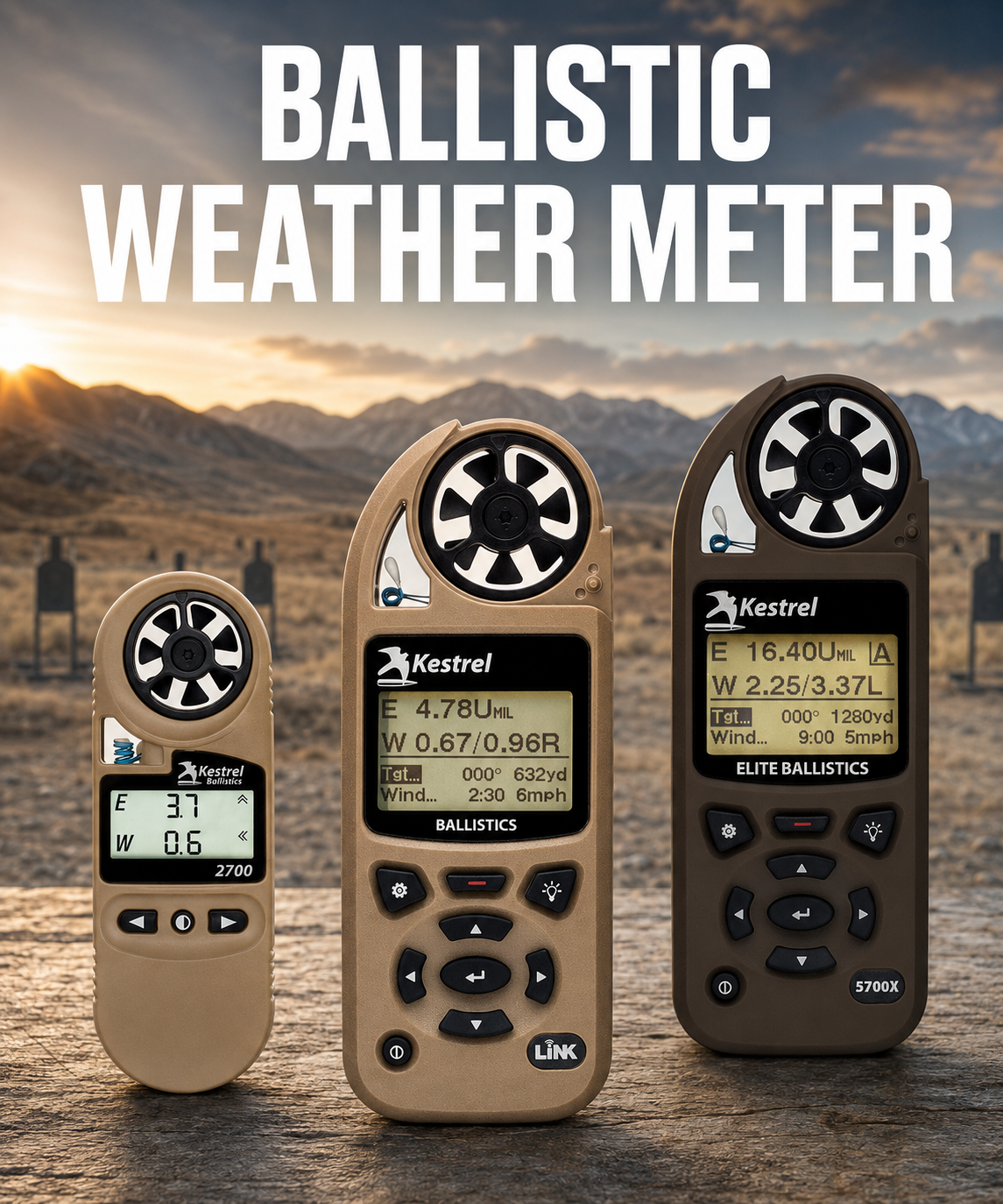
For most shooters, Kestrel meters are the leading name in this category. Options range from the straightforward Kestrel 2700 to the advanced Kestrel 5700X Elite with Applied Ballistics. The right model depends on how far you shoot, how many rifle profiles you use, and whether you need advanced calculations such as spin drift, Coriolis effect, and aerodynamic jump.
This guide explains the essential features, display quality, battery performance, and differences between today’s most useful ballistic weather meters, with a focus on which all in one unit options make the most sense for shooters comparing environmental measurements with ballistic calculation capability.
Disclosure: This article contains affiliate links. We may earn a commission from qualifying purchases at no additional cost to you.
Best Ballistic Weather Meters at a Glance
Ballistic weather meter | Best for | Ballistic capability | Key advantage |
|---|---|---|---|
Kestrel 2700 | Hunters and new long-range shooters | G1/G7 solutions to 875 yards | Simple three-button operation |
Kestrel 5700 | Recreational and competitive shooters | Ballistic calculator with environmental measurements | Strong balance of capability and usability |
Kestrel 5700 Elite | Serious long-range shooters | Full Applied Ballistics solver | Advanced corrections and multiple profiles |
Kestrel 5700X Elite | Competition and professional use | Faster Applied Ballistics calculations | Faster processor and rapid target engagement |
Top Ballistic Weather Meter Options
Best Overall Buy
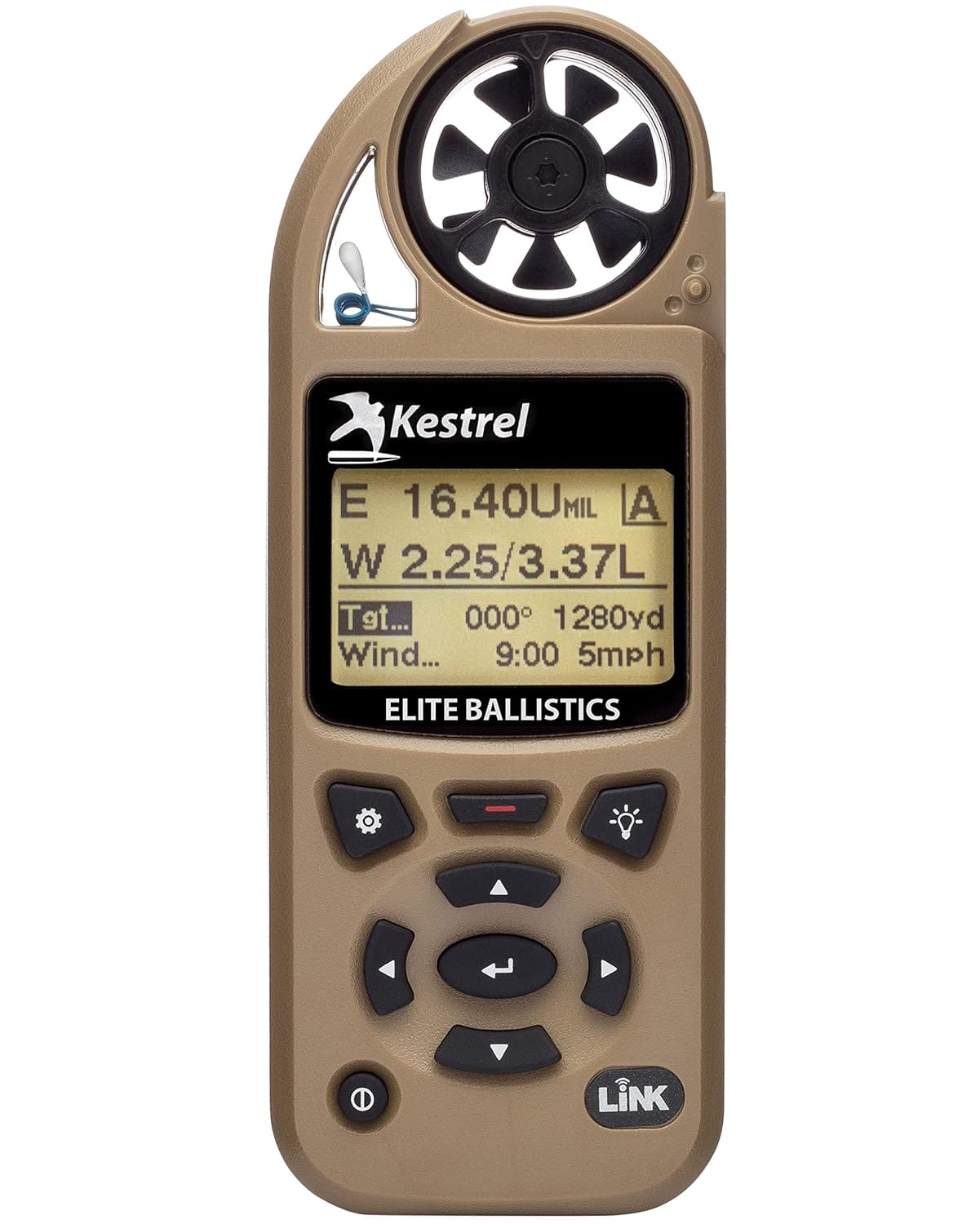
The Kestrel 5700 Elite is the best overall ballistic weather meter for shooters who want an integrated weather meter with comprehensive environmental measurements and a full-featured ballistic solver in one rugged handheld device.
- Accurate Environmentals – Measures wind speed, wind direction, air pressure, and temperature, G1/G7 Ballistics Solver – Large library of lab tested bullet data. Expect extreme accuracy out to the max range of 875yds
- Customizable Shooting Solutions - Ballistics data specific to your rifle, bullet, and scope, Single Target Display - Easily view the elevation and windage solutions for your shot
- Wind Capture - Intuitive Wind Capture feature instantly measures and adjusts for real-time wind conditions, User-Friendly – Simple 3 button operation and Easy Mode step-by-step guidance on getting started
- Rugged, All-Weather Durability – IP-67 Waterproof, MIL-STD-810 drop-tested, long life battery, and backed by 5-Year Warranty, Protective Slip-On Cover – Slides over the entire unit for added durability
- Load & Go Convenience – Upload a gun profile for your specific rifle and bullet in the 2700 using the free Kestrel LiNK Ballistics app, then leave your phone behind – the 2700 is a fully functional, stand-alone field tool Free Kestrel LiNK Ballistics App – View solutions remotely and easily build, store, and transfer gun and bullet data to and from unit and view solutions remotely with LiNK App
Compared with simpler units, the Elite’s Applied Ballistics engine gives you one of the more full featured ballistics calculators here, with stronger ballistics solver capabilities for shooters who need deeper trajectory inputs and better long-range refinement.
Its solver uses exact physical modeling of mass and aerodynamic properties, not just custom drag models, and accounts for factors such as:
- Bullet drop for a more accurate aim point and precise elevation
- Wind deflection
- Aerodynamic jump
- Spin drift
- Coriolis effect
- Density altitude
- Drop Scale Factor
- Rifle and ammunition characteristics
The Elite can store up to 30 gun and ammunition profiles and 10 targets, making it suitable for shooters who regularly switch between different rifles or loads. Its LiNK Bluetooth connectivity allows profile management through the Kestrel LiNK Ballistics app and communication with compatible laser rangefinders.
The display is large, high-resolution, and high-contrast, allowing it to remain visible in bright sunlight. A dual-color backlight helps preserve night vision during early-morning, nighttime, or low-light shooting.
A Kestrel 5700 Elite with HUD Kit costs about €1,155.59.
Best for: Precision rifle competitors, advanced hunters, shooting instructors, and serious long-range enthusiasts.
Best Value
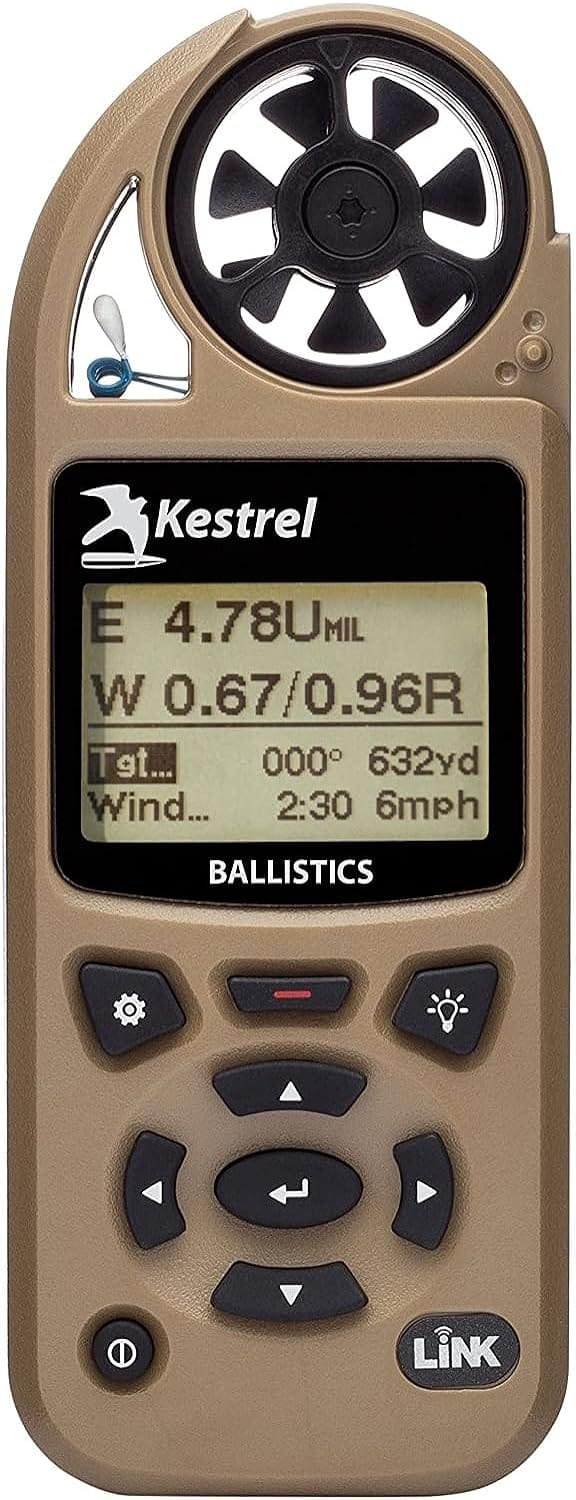
- Data Log Graph View / Data Logging - Adjustable Interval / Date & Time / Digital Compass
- Drop-Tested to MIL-STD-810G / Floats / High Contrast, Sunlight Readable Monochrome LCD Display
- Integrated Flip Open Impeller Cover / Intuitive Tactile Up/Down/Enter Keypad / Minimum/Maximum/Average Reading
- Pressure Sensor / Relative Humidity Sensor / Temperature Sensor (Patented External Isolated) / Waterproof to IP67 (3'/1M for 30 minutes)
The standard Kestrel 5700 Ballistics Weather Meter is a comprehensive weather meter that also works like a portable weather station in the field, while keeping the interface and ballistic capabilities more approachable than the Elite.
It measures environmental factors that influence a bullet’s trajectory, including:
- Wind speed
- Wind direction
- Crosswind
- Headwind and tailwind
- Temperature
- Relative humidity
- Barometric pressure
- Station pressure
- Density altitude
- Altitude
It captures crucial environmental data and environmental data for trajectory corrections without forcing the user to rely on a phone.
The standard 5700 is an excellent choice for shooters who want dependable firing solutions but do not require the complete Applied Ballistics feature set. It retains the rugged construction, sunlight-readable display, weather measurement tools, and optional wireless connectivity of the 5 Series platform.
One important advantage is upgradability. Depending on the model and current manufacturer support, owners may be able to upgrade the ballistic software later rather than replacing the complete meter. At about $469, it offers tremendous value for shooters who want more than the 2700 without stepping up to Elite pricing.
Best for: Recreational long-range shooting, PRS practice, hunting, and shooters moving beyond basic ballistic apps.
Best for Beginners
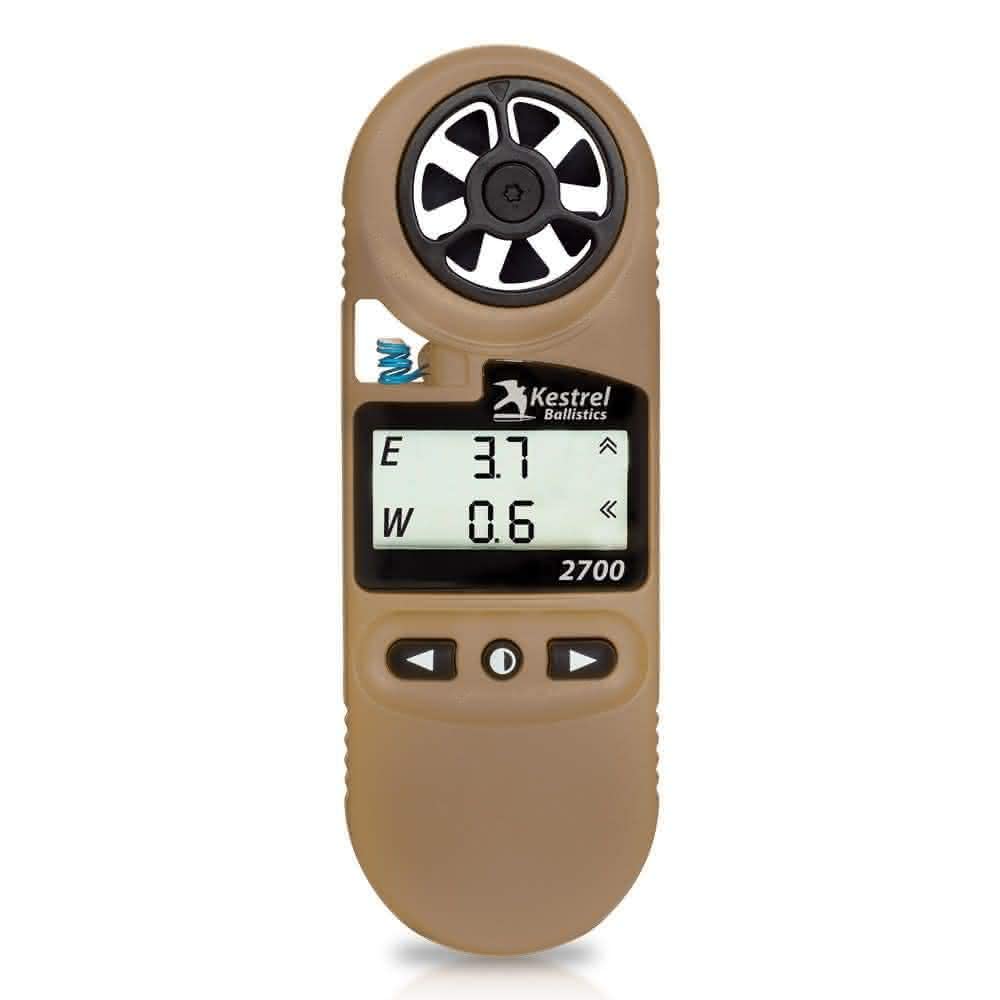
The Kestrel 2700 is a kestrel ballistics meter for beginners who want accurate environmental readings and useful ballistic solutions without navigating the deeper menus of a professional-grade system.
It measures wind speed, wind direction, air pressure, and temperature. Its G1/G7 ballistic solver uses a library of tested bullet data and calculates shooting solutions out to a maximum listed range of 875 yards.
Easy Mode provides step-by-step setup guidance, while the three-button interface makes the unit less intimidating for first-time users. Shooters can build a rifle and ammunition profile in the Kestrel LiNK Ballistics app, transfer it to the meter, and then use the 2700 as a stand-alone field tool that works without cellular service, which makes it dependable for backcountry hunting trips.
The unit is IP67 waterproof and MIL-STD-810 drop-tested. That makes it appropriate for hunting packs, shooting bags, and changing outdoor conditions.
- Accurate Environmentals – Measures wind speed, wind direction, air pressure, and temperature, G1/G7 Ballistics Solver – Large library of lab tested bullet data. Expect extreme accuracy out to the max range of 875yds
- Customizable Shooting Solutions - Ballistics data specific to your rifle, bullet, and scope, Single Target Display - Easily view the elevation and windage solutions for your shot
- Wind Capture - Intuitive Wind Capture feature instantly measures and adjusts for real-time wind conditions, User-Friendly – Simple 3 button operation and Easy Mode step-by-step guidance on getting started
- Rugged, All-Weather Durability – IP-67 Waterproof, MIL-STD-810 drop-tested, long life battery, and backed by 5-Year Warranty, Protective Slip-On Cover – Slides over the entire unit for added durability
- Load & Go Convenience – Upload a gun profile for your specific rifle and bullet in the 2700 using the free Kestrel LiNK Ballistics app, then leave your phone behind – the 2700 is a fully functional, stand-alone field tool Free Kestrel LiNK Ballistics App – View solutions remotely and easily build, store, and transfer gun and bullet data to and from unit and view solutions remotely with LiNK App
The Kestrel 2700 is priced around $205.75.
Best for: Deer hunters, youth shooters, beginners, and long range hunters who want simple field-ready data rather than advanced ELR features, especially when shooting inside 875 yards.
Best for Competition
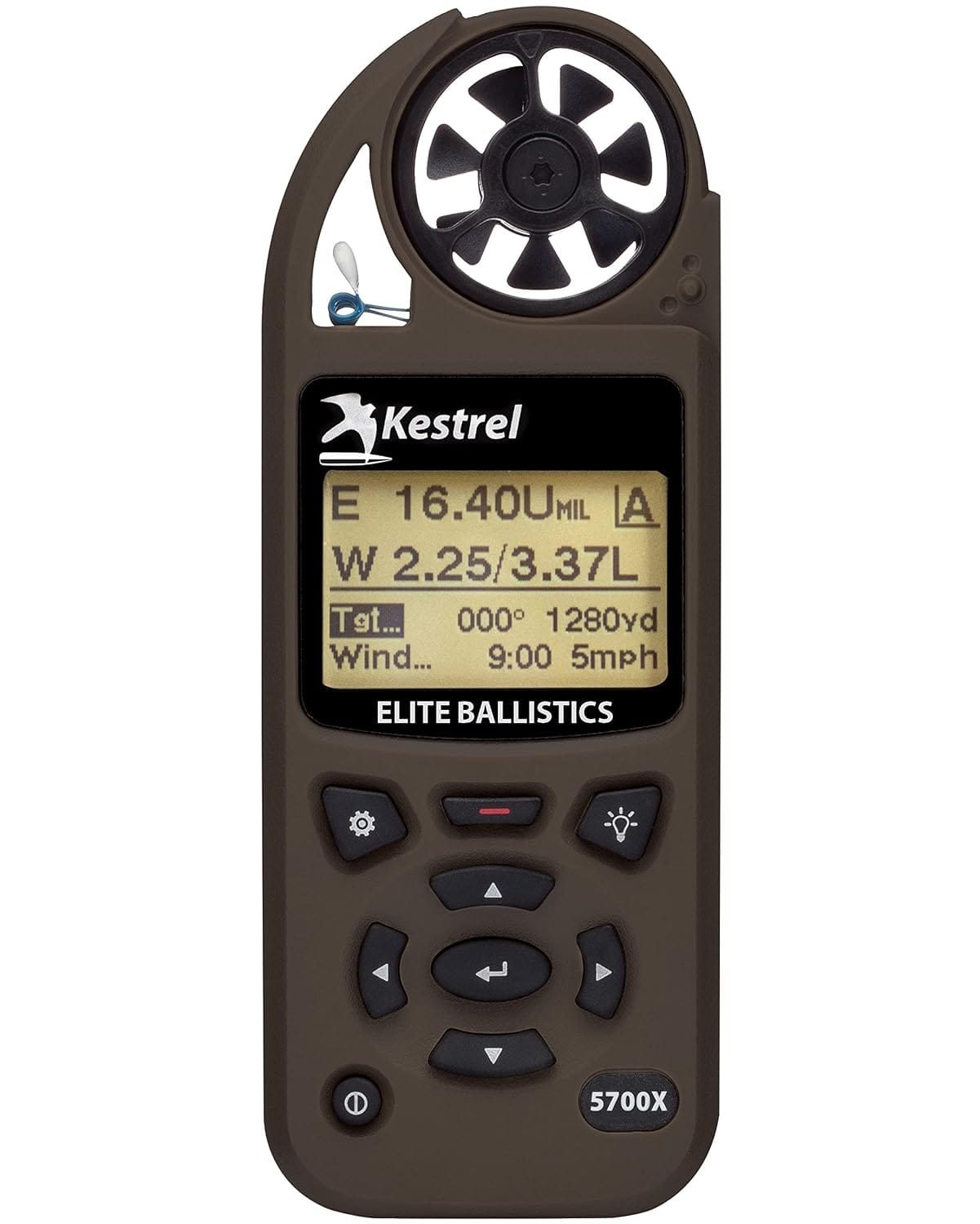
The Kestrel 5700X Elite builds on the Elite platform with a faster processor. Its greatest advantage is speed when calculating and updating firing solutions for multiple targets.
That difference matters during timed shooting stages where the shooter must range several targets, use real time environmental measurements as conditions shift, and engage each target quickly. The 5700X Elite can store as many as 30 gun profiles and 10 targets while providing the advanced calculations expected from the Applied Ballistics solver.
Its weather mode measures wind, direction, temperature, humidity, pressure, altitude, and other environmental conditions. Bluetooth Low Energy connectivity supports compatible mobile devices, computers, and selected laser rangefinders. Most high-end Kestrel models are portable and built to withstand harsh environments.
However, the 5700X does not include every interface feature found on the regular Elite. Kestrel notes that the 5700X does not offer Easy Mode or the MV Cal Guide, although muzzle velocity can still be calibrated. Experienced users may not miss these features, but new users could find the regular Elite easier to learn.
- Employs the Applied Ballistics bullet library of custom drag models, an exact measurement of your bullet’s drag profile plus corrections for Aerodynamic Jump, Spin Drift, Coriolis, and Drop Scale Factoring to deliver more precise trajectory solutions and accurate shooting solutions at extended long range
- Expanded features include a customizable Target Card and an expanded Ballistics Data Table, as well as storage for up to 30 gun and bullet profiles and 10 saved targets
- Weather mode offers the full environmental measurements, storage and charting capabilities of the Kestrel 5500 Weather Meter, including wind speed, direction, crosswind, temperature, humidity, pressure and altitude
- LiNK connectivity powered by Bluetooth low energy provides wireless communication to mobile devices and computers and integration with LiNK compatible laser range finders for improved speed and accuracy
- Large, hi-res, hi-contrast, graphic display is perfectly readable in the brightest sunlight. Includes both bright white and night-vision-preserving red backlight
Pricing is firmly premium: the Kestrel 5700X WEZ is about €938.56, while the Kestrel 5700X Elite & HUD Long Range Shooter Kit is about €1,221.35.
Best for: PRS competitors, military or law-enforcement professionals, and experienced shooters who prioritize calculation speed.
What Is a Ballistic Weather Meter?
A ballistic weather meter is an easily deployable weather station combined with a ballistic calculator in a handheld unit. Unlike a basic wind meter, it does not merely tell you how fast the wind is moving. That matters because critical weather can change long-range shooting decisions in ways a simple wind reading cannot. It uses environmental information and firearm data to estimate the elevation and windage corrections needed for a particular shot.
A typical firing solution uses information such as:
- Target distance
- Wind speed and direction
- Rifle zero
- Scope height
- Muzzle velocity
- Bullet weight and diameter
- Ballistic coefficient or custom drag model
- Temperature
- Atmospheric pressure
- Shooting angle
The meter processes these ballistic variables and provides an elevation adjustment and wind hold, usually in MILs, MOA, clicks, or another user-selected unit.
A ballistic weather meter does not replace marksmanship, careful wind observation, or verified rifle data. Its output will only be as reliable as the information entered into it.
Essential Ballistic Weather Meter Features
Accurate Wind Speed Measurement
Wind is often the most difficult variable to judge during a long-range shot. A built-in impeller measures the wind at the shooter’s position, providing onsite environmental measurements and giving the ballistic solver a real environmental reading instead of a guess.
Keep in mind that wind at the firing line may differ from wind midway to the target. Shooters still need to observe mirage, vegetation, dust, range flags, and terrain, because those impeller readings are accurate measurements at the shooter, not a substitute for judging downrange wind.
Pressure and Density Altitude
Air density affects how quickly a bullet loses velocity. Pressure, temperature, and humidity contribute to density altitude, which gives the shooter a practical picture of current atmospheric conditions.
A rifle zeroed at low elevation on a cool day may behave differently at high elevation in hot weather. Automatic environmental measurement reduces the chance of entering outdated weather information.
G1, G7, and Custom Drag Models
Entry-level ballistic meters frequently support G1 and G7 ballistic coefficients. G7 is generally better suited to modern boat-tail rifle bullets, while G1 remains common in manufacturer specifications. Another approach is the Hornady 4DOF ballistic calculator, which delivers accurate long-range shooting with trajectory solutions based on more detailed bullet modeling and has been trusted since 2016.
More advanced Applied Ballistics meters support custom drag models based on measured bullet performance. These can provide better predictions across long distances because they represent the drag behavior of specific projectiles more accurately than a generalized coefficient. Hornady 4DOF is especially well suited to low-drag precision bullets, where its four-degree-of-freedom method can outperform simpler coefficient-based models.
Gun and Ammunition Profiles
A useful ballistic weather meter should let you store the following:
- Rifle name
- Bullet data
- Muzzle velocity
- Zero distance
- Sight height
- Scope adjustment units
- Twist direction and rate
- Ballistic coefficient or drag model
Multiple-profile storage is especially valuable if you own several rifles or use different ammunition in the same rifle.
Bluetooth Connectivity
Bluetooth allows the meter to communicate with a phone, tablet, computer, or compatible laser rangefinder, with the Kestrel Link app serving as the mobile interface for wireless setup and data transfer. The primary benefit is easier profile creation. Typing ammunition data into an app is usually faster than entering every value through the meter’s physical buttons. There is also android wireless connectivity for shooters using Android phones or tablets.
Wireless connectivity can also allow a compatible rangefinder to transmit target distance directly to the ballistic solver. The calculated solution may then appear on the rangefinder, meter, or connected device through the LiNK wireless communication option.
Rugged Construction
A ballistic meter will likely encounter dust, rain, freezing temperatures, and occasional drops. Premium ballistic weather meters are built to withstand harsh environments and repeated field carry. Look for:
- Waterproof construction
- Drop-tested housing
- Protective lens
- Replaceable impeller
- Secure battery compartment
- Lanyard attachment
- Protective storage cover
Kestrel’s 5 Series meters are designed as waterproof, drop-tested field instruments, and carry pouch options can make transport and storage easier in hunting packs or range bags. Kestrel also states that its meters can float and withstand temporary submersion, although owners should follow the specific care instructions for their model.
Ballistic Weather Meter Display Quality
Display quality is easy to overlook when shopping, but it has a major effect on field usability.
Sunlight Readability
A smartphone can become difficult to read in direct sunlight. Kestrel 5 Series meters use a high-resolution, high-contrast monochrome display that remains visible outdoors without depending on an intensely illuminated screen.
This also helps conserve battery power.
Backlight
The dual-color backlight provides visibility during low-light conditions. A subdued red backlight is useful when the shooter wants to minimize the loss of natural night vision, while a brighter setting is convenient for general use.
Use the backlight only when necessary because continuous illumination reduces battery life.
Screen Organization
An effective display should make the most important information easy to identify:
- Precise elevation correction
- Windage correction
- Target range
- Wind speed
- Wind direction
- Selected rifle profile
The Kestrel 2700 uses a simpler single-target presentation. Advanced 5700 models provide more detailed ballistic data, target cards, environmental screens, and configurable data tables.
A bigger feature list is not automatically better. Hunters who need one quick solution may prefer the 2700 interface, while competitors engaging multiple targets will benefit from the Elite’s long range holdovers and more detailed target-card data.
Battery Life and Power
Battery performance depends on the meter, temperature, backlight use, data logging, and Bluetooth activity.
Kestrel 2700 Battery
The Kestrel 2700 uses a replaceable CR2032 coin-cell battery. According to the manufacturer, typical operation without frequent app use can provide approximately 130 hours of battery life. Heavy Bluetooth use will reduce that figure.
Coin batteries are compact and easy to carry, so storing a spare in a protected section of the range bag is sensible.
Kestrel 5700-Series Battery
Kestrel 5700-series meters use one replaceable AA battery. A disposable lithium AA is generally the best field choice because it performs well across a wider temperature range and is less prone to leakage than an alkaline battery.
The AA system offers several benefits:
- Batteries are widely available
- Replacements are inexpensive
- No charging cable is required
- A spare adds very little weight
- Lithium batteries perform well in cold weather
Actual runtime varies considerably with Bluetooth, backlight, logging interval, and weather conditions. Continuous wireless communication consumes more power than using the meter independently.
How to Extend Battery Life
- Turn Bluetooth off when it is not needed.
- Reduce backlight brightness and timeout duration.
- Use a longer data-logging interval.
- Keep spare batteries dry and protected.
- Remove the battery before very long storage periods.
- Use manufacturer-recommended lithium batteries in cold weather.
- Inspect the battery compartment for dirt or moisture.
How to Choose the Right Ballistic Weather Meter
Choose the Kestrel 2700 If:
- You normally shoot inside 875 yards.
- You want a simple interface.
- You use one primary rifle profile.
- You do not need advanced ELR calculations.
- Price and ease of use matter more than maximum capability.
Choose the Standard Kestrel 5700 If:
- You want a full environmental meter.
- You shoot recreationally at longer distances.
- You want room to develop your skills.
- You prefer the larger 5 Series display and controls.
- You may want expanded capabilities later.
Choose the Kestrel 5700 Elite If:
- You want the complete Applied Ballistics solver.
- You use several rifles and loads.
- You shoot at extended ranges.
- You need spin drift, Coriolis, and aerodynamic-jump corrections.
- You want Easy Mode and muzzle-velocity calibration guidance.
Choose the Kestrel 5700X Elite If:
- You compete under time limits.
- You regularly engage multiple targets.
- Calculation speed is a priority.
- You already understand ballistic profile setup.
- You do not need Easy Mode or the MV Cal Guide.
How to Use a Ballistic Weather Meter
- Build an accurate rifle profile. Enter verified bullet, rifle, scope, zero, and muzzle-velocity information.
- Confirm muzzle velocity. Use a dependable chronograph and record several shots rather than relying exclusively on the velocity printed on an ammunition box.
- Verify the zero. Confirm the actual zero distance and measure sight height correctly.
- Select the correct rifle profile. This is particularly important when several profiles are stored.
- Capture the environment. Allow the meter to acclimate to outside conditions. Avoid warming the temperature sensor with your hands or body.
- Measure the wind. Point the impeller into the wind and use the wind-capture function when available.
- Enter target information. Add the distance, shooting angle, and direction when required.
- Read the solution. Apply the displayed elevation and windage correction using the same units as the scope.
- Record confirmed impacts. Use field results to refine muzzle velocity, zero, or drag information when appropriate.
Common Ballistic Weather Meter Mistakes
Using Advertised Muzzle Velocity
Factory ammunition velocities are measured under specific test conditions. Your rifle’s barrel length and chamber can produce a different result. Chronograph the actual rifle and ammunition combination.
Measuring Temperature Incorrectly
A meter carried against the body may initially report an artificially high temperature. Let it hang in the shade with airflow around the sensor until it adjusts to ambient conditions.
Treating Firing-Line Wind as the Entire Wind Call
The meter measures wind where it is located. It cannot directly measure every wind change between the muzzle and target.
Mixing MIL and MOA
Confirm that the solver and riflescope use matching units. A correct solution in the wrong unit can result in a substantial miss.
Ignoring Scope Height or Zero Distance
Small profile errors become increasingly important as target distance grows. Measure the distance from the center of the bore to the center of the scope rather than guessing.
Frequently Asked Questions
What is the best ballistic weather meter?
The Kestrel 5700 Elite is the best overall option for most serious long-range shooters. It combines comprehensive weather measurements, an Applied Ballistics solver, multiple gun profiles, advanced trajectory corrections, and Bluetooth connectivity. The 5700X Elite is better when faster calculations are essential.
Is the Kestrel 2700 good enough for hunting?
Yes. The Kestrel 2700 is an excellent hunting option for shots within its listed 875-yard solution range. It measures wind, direction, pressure, and temperature while providing a simple G1/G7 ballistic solution.
What is the difference between a wind meter and a ballistic weather meter?
A basic wind meter measures wind speed and possibly other environmental conditions. A ballistic weather meter also calculates bullet trajectory using environmental, rifle, ammunition, and target data.
Does a ballistic weather meter measure wind at the target?
No. A handheld meter measures wind at its current location. Shooters must still evaluate wind along the complete bullet path through terrain, mirage, vegetation, and other indicators.
Can a ballistic weather meter replace a rangefinder?
No. A meter calculates a shooting solution, while a rangefinder measures target distance. Some ballistic meters can connect to compatible rangefinders so the devices share information.
Does Bluetooth reduce battery life?
Yes. Frequent or continuous Bluetooth communication uses additional power. Turning wireless connectivity off when it is unnecessary can extend battery life.
Can you use a ballistic weather meter without a phone?
Yes. Once the proper rifle profile is loaded, Kestrel ballistic meters can provide stand-alone field solutions. A phone makes profile creation and management easier but is not always required at the firing position.
Are ballistic weather meters waterproof?
Many Kestrel ballistic models are waterproof and designed for field use. The Kestrel 2700 is listed as IP67 waterproof and MIL-STD-810 drop-tested. Always confirm the specifications of the exact model being purchased.
Is a ballistic weather meter worth the money?
It is worthwhile for shooters who regularly hunt or shoot beyond distances where changing wind and atmospheric conditions create meaningful trajectory differences. Inside short ranges, a rangefinder and verified drop chart may be sufficient.
How accurate is a ballistic weather meter?
The environmental sensors and solver can be extremely accurate, but the final solution depends on correct inputs. Incorrect muzzle velocity, sight height, zero distance, bullet selection, or wind direction can produce an incorrect firing solution. Some advanced engines, including Hornady 4DOF, also calculate vertical shift from crosswinds in addition to standard drop and drift inputs.
Final Thoughts
The best ballistic weather meter is the one that provides enough capability without creating unnecessary complexity.
The Kestrel 2700 is the practical choice for hunters and newer shooters who want straightforward solutions inside 875 yards. The standard Kestrel 5700 provides a stronger general-purpose platform for developing long-range skills. The Kestrel 5700 Elite offers the best overall combination of advanced calculations, profile capacity, durability, and usability. The 5700X Elite is the premium choice for experienced competitors who need faster processing across multiple targets.
Whichever model you select, accurate rifle data remains essential. The best models are portable all-in-one units that combine environmental sensing with trajectory solutions, trusted by long range hunters and even demanding users such as combat weather teams in harsh field conditions. Confirm the rifle’s zero, measure real muzzle velocity, verify scope dimensions, and practice reading wind across the entire range. A ballistic weather meter is an exceptional decision-making tool, but its value ultimately depends on the quality of the information entered and the shooter’s ability to apply the solution safely. Order today!