

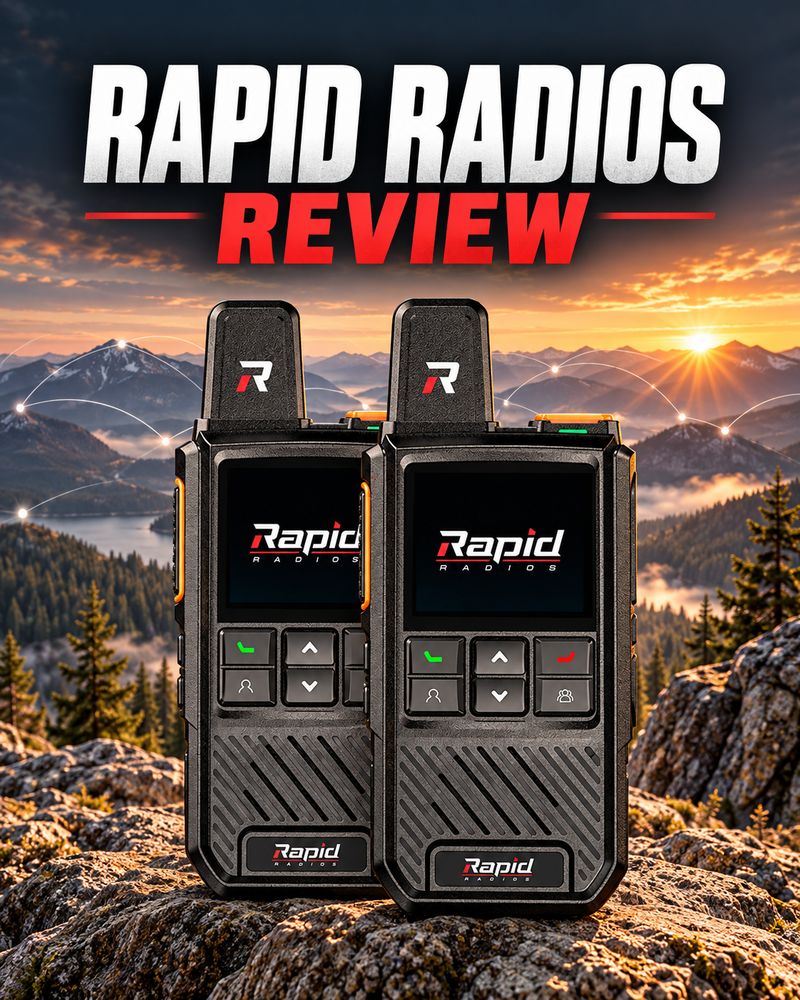
The Rapid Radios RAD1 combines the convenience of a walkie-talkie with the reach of cellular and Wi-Fi networks. Press one button, and you can talk to a family member, employee, or hunting partner hundreds—or even thousands—of miles away. There is no number to dial, no complicated programming, and no FCC radio license to obtain.
That sounds like a major upgrade over a traditional handheld radio, but there is one important fact every buyer needs to understand: Rapid Radios rely on LTE cellular networks. They are not off-grid radios, satellite communicators, or a replacement for a GMRS, ham, or emergency two-way radio when cell towers are unavailable.
The RAD1 is now the model to look at first. Compared with the less expensive G1, it adds an IPX6 weather-resistant housing designed to float, Wi-Fi backup, and a paging feature. The G1 remains available as the value choice for buyers who do not need the RAD1’s extra protection and connectivity.
Quick Verdict
The Rapid Radios RAD1 is our overall pick for people who want fast group communication across town or across the country without relying on a smartphone. Its combination of multi-carrier LTE, Wi-Fi backup, IPX6 protection, and simple push-to-talk controls makes it the most versatile Rapid Radios handheld.
The RAD1 still requires an LTE or Wi-Fi connection, so it is not a true off-grid radio. It should not be the only communication device carried into remote country or depended on after a widespread network outage. Buyers should also account for the annual renewal fee that begins after the included first year.
Best overall: Rapid Radios RAD1 for contractors, outdoor crews, farms, road trips, event staff, and families that want the added protection of a rugged, floating IPX6 radio.
Best value: Rapid Radios G1 for general family or work communication when Wi-Fi backup and weather protection are not priorities.
Skip them if: you need off-grid communication, direct radio-to-radio operation, satellite SOS capability, or a device that works without an active service plan.
Rapid Radios RAD1: The rugged IPX6 handheld adds Wi-Fi backup, paging, and a floating housing to the nationwide LTE push-to-talk platform.
What Are Rapid Radios?
Rapid Radios look and operate like handheld two-way radios, but the technology inside is closer to a simplified cellular device. The featured RAD1 uses Push-to-Talk over Cellular (PoC). A preinstalled IoT SIM connects the unit to an available LTE network, and voice is carried as data between radios assigned to the same talk group. The RAD1 can also use Wi-Fi when a suitable cellular connection is unavailable.
Rapid Radios is associated with Rapid Consulting LLC, a Michigan-based company serving customers across the USA. The company is committed to making wide-area push-to-talk communication simple for families, mobile crews, and businesses that do not want to program conventional radios.
This design removes the short-distance limitations of standard FRS and GMRS handhelds. Two Rapid Radios do not need to be within a few miles of each other. One user can be in Kentucky and another in Arizona, and they can still communicate as long as both radios have compatible LTE coverage and active service.
The radios arrive programmed and paired to the buyer’s group. Turn them on, wait for a cellular connection, hold the push-to-talk button, and speak. Group broadcasts can reach everyone in the talk group, while private one-to-one communication is also supported.
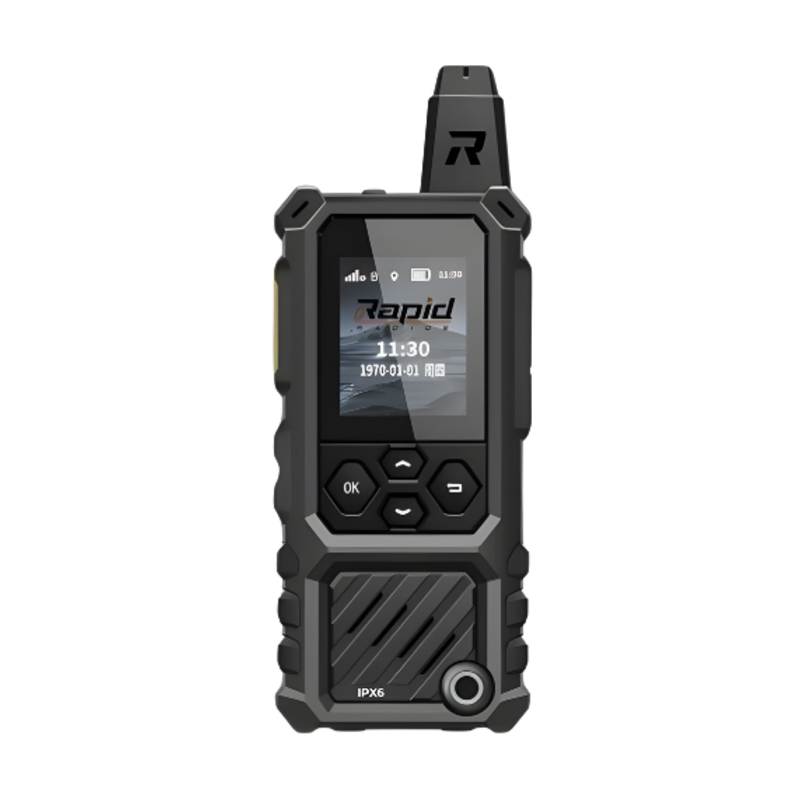
Rapid Radios RAD1 Specifications
| Feature | Rapid Radios RAD1 |
|---|---|
| Communication type | Push-to-Talk over Cellular (PoC) |
| Coverage | United States where supported LTE or Wi-Fi service is available |
| Connectivity | Multi-carrier LTE plus Wi-Fi backup |
| Water protection | IPX6 weather-resistant; designed to float |
| Included service | First 12 months |
| Renewal cost | $50 per year per radio, or $40 with autopay |
| Group capacity | Up to 200 users |
| Communication modes | Group talk, private one-to-one talk, and paging |
| Claimed standby time | 5+ days |
| Charging | USB-C with supplied charger |
| Dimensions | 2 × 1.25 × 5.75 inches |
| License required | No individual FCC radio license |
| Warranty | 12-month parts warranty |
Rapid Radios RAD1 Features: The upgraded model combines IPX6 protection, LTE and Wi-Fi connectivity, paging, group communication, and more than five days of claimed standby time.
Prices and promotions can change, but the company listed one RAD1 at $399 and a two-radio package at $699 when this article was updated. The first year of nationwide service is included with each radio.
Check Amazon: View the Rapid Radios RAD1 Two-Pack on Amazon
Amazon lists the rugged RAD1 two-pack with LTE, Wi-Fi, IPX6 weather resistance, paging, and group communication. Verify the current price, seller, included service, and renewal terms before ordering.
Rapid Radios RAD1 vs. G1: Which Should You Buy?
The RAD1 and G1 use the same basic Push-to-Talk over Cellular concept, but they are not simply two names for an identical radio. The RAD1 is the better-equipped model and the focus of this review. The G1 costs less and remains a sensible alternative for lighter-duty use.
| Feature | Rapid Radios G1 | Rapid Radios RAD1 |
|---|---|---|
| Connectivity | Multi-carrier LTE | LTE plus Wi-Fi |
| Water protection | No IP rating listed on the G1 product page | IPX6 weather-resistant rating advertised |
| Communication modes | Private and group talk | Private talk, paging alerts, and group talk |
| Maximum group size | Up to 200 users | Up to 200 users |
| Battery claim | More than five days of standby time; 8,800 mAh listed | More than five days of standby time; capacity not listed |
| Charging | USB-C with the supplied charger | USB-C with the supplied charger |
| Accessory connection | K-type earpiece connection | K-port accessory support |
| Included service | First year included | First year included |
| Standard renewal | $50 per year for each radio | $50 per year for each radio |
| Best fit | Families and general work crews | Outdoor crews needing better weather protection and Wi-Fi support |
The most meaningful RAD1 upgrades are IPX6 weather resistance and the ability to use Wi-Fi in addition to LTE. Wi-Fi may help inside a building or at a location where cellular reception is weak but a dependable internet connection is available. It does not make the RAD1 an off-grid radio, as the device still requires network access.
The RAD1 is the better overall radio for construction, security, outdoor events, marine use, and demanding family travel. The G1 is the better value for ordinary family, road-trip, or workplace communication where the radio will not regularly be exposed to rain or harsh conditions.
Prices change, but the direct-sale G1 two-pack was listed around $399 when this article was updated, while the RAD1 two-pack on Amazon was listed around $699. Buyers should check both listings before deciding, as a sale could change which model offers better value.
How Far Do Rapid Radios Work?
Rapid Radios do not have a conventional mileage rating. Their usable distance is effectively unlimited between areas with compatible network coverage. The radios can be separated by a job site, an entire state, or even most of the country because they communicate over LTE or Wi-Fi infrastructure rather than directly with each other.
That is the source of the company’s nationwide coverage, nationwide range, and “unlimited range” descriptions. Distance is not the limiting factor; network availability is. Nationwide coverage means the radios can communicate across the USA wherever a supported LTE connection is available—it does not mean completely uninterrupted coverage in every rural or remote location.
This distinction matters. If both users have service, a conversation over 1,500 miles may be clearer and more reliable than a traditional handheld radio used on a hilly five-mile route. If one user enters a deep canyon, remote forest, or cellular dead zone, however, the Rapid Radio cannot fall back to ordinary radio-to-radio communication.
Do Rapid Radios Work Without Cell Towers?
No. Rapid Radios require access to a supported LTE network. They do not communicate directly with one another when cellular coverage disappears.
The RAD1 uses a multi-carrier IoT SIM rather than being locked to a single consumer carrier. That may improve the odds of finding usable LTE service in places where one network is weak and another is strong. Its Wi-Fi backup adds another way to connect, but it still needs functioning network infrastructure.
This makes Rapid Radios very different from several other communication tools:
- FRS and GMRS radios communicate directly and can operate without external infrastructure, although their real-world range is much shorter than many package claims suggest.
- Ham radios can provide direct or repeater-assisted communication, but require knowledge, programming, and usually an amateur radio license.
- Satellite communicators can reach emergency or messaging services beyond cellular coverage but normally require a subscription and a clear view of the sky.
- Rapid Radios offer easy, long-distance push-to-talk communication but depend on commercial cellular networks and an active service plan.
For emergency planning, the safest approach is to treat Rapid Radios as a convenient cellular communication tool—not as the only radio in the kit.
Are There Monthly Fees?
Rapid Radios do not have a monthly fee, but they are not free to operate indefinitely. The purchase includes 12 months of service. After that, the current nationwide service costs $50 per radio per year, or $40 per radio with automatic renewal.
For a two-radio set, that means a standard renewal cost of $100 per year. A six-radio crew would pay $300 per year at the regular rate. The cost is modest compared with maintaining full smartphone plans for every worker, but it should still be included when comparing Rapid Radios with ordinary two-way radios.
Without renewed cellular service, the radios cannot provide their normal push-to-talk communication. The hardware and service therefore work as a package.
There are no monthly contracts, which may help a business save money compared with cellular plans billed every month. However, the required annual renewal should remain part of the long-term cost calculation.
What Rapid Radios Do Well
Simple Push-to-Talk Operation
The biggest advantage is ease of use. There are no telephone numbers, apps, channel frequencies, or radio menus to manage during a basic group conversation. A user selects the correct group, holds the side button, speaks, and releases it to listen.
That simplicity can be valuable for older family members, employees wearing gloves, drivers who need minimal distraction, or teams that do not want personal phones mixed into daily operations.
Long-Distance Group Communication
Conventional handheld radios become unreliable as terrain, buildings, and distance increase. Rapid Radios avoid most of those range problems by sending voice over LTE. A contractor can speak with crews at separate sites, or a road-trip group can remain connected even after vehicles become widely separated.
Multi-Carrier Connectivity
The included IoT SIM is designed to connect to major LTE networks rather than relying on a single carrier. This can provide a useful coverage advantage, particularly for teams that travel through different service areas.
No Radio Programming or License
The radios arrive configured for the customer’s group, so buyers do not need to learn frequencies, tones, repeaters, or programming software. Because the system uses cellular data rather than licensed GMRS or amateur-radio operation, the user does not need to purchase an individual radio license.
Private and Large-Group Options
Rapid Radios supports private one-to-one conversations and group communication with up to 200 users. That flexibility is useful for a small family set as well as a larger work crew.
Where Rapid Radios Fall Short
They Are Not Off-Grid Radios
This is the most important limitation. The radios are ineffective in a true cellular dead zone or during a widespread network outage. Anyone buying them primarily for hunting in remote country, backcountry hiking, or post-disaster communication should carry an independent alternative.
Annual Service Is Required
“No monthly fees” is technically accurate, but the phrase can leave buyers with the wrong impression. Service must be renewed annually after the first 12 months. That ongoing expense increases with each radio in the group.
They Communicate Within Their System
Rapid Radios are not normal cellular phones. They do not replace a smartphone, place ordinary telephone calls, or communicate with random FRS, GMRS, CB, or ham radios. They are intended to speak with compatible devices assigned to the relevant talk group.
The Purchase Price Is High
A two-pack costs much more than a basic pair of FRS radios. The added money buys long-distance LTE connectivity, easy setup, and managed service—not superior off-grid capability.
Service Depends on the Provider
Like other managed PoC products, long-term usefulness depends on the company continuing to support the radios, SIM connections, and talk-group platform. Traditional direct-mode radios do not carry that same provider dependency.
Rapid Radios vs. Traditional Walkie-Talkies
| Comparison | Rapid Radios | Traditional FRS/GMRS Radios |
|---|---|---|
| Network required | Yes, LTE | No for direct communication |
| Practical distance | Nationwide where LTE is available | Usually local and affected by terrain |
| Recurring cost | Annual service after first year | Usually none |
| Setup | Preprogrammed and ready to use | Channel selection; some models require programming |
| Works in a cell dead zone | No | Yes, within direct radio range |
| Best use | Widely separated users and mobile teams | Local outdoor, neighborhood, and emergency communication |
Neither type replaces the other. Rapid Radios are stronger when users are far apart but still within cellular coverage. Traditional radios are more reliable when infrastructure is unavailable, and everyone remains within radio range.
Who Should Buy Rapid Radios?
Rapid Radios make the most sense when instant group communication matters more than off-grid independence. Good applications include:
- Contractors coordinating crews at multiple locations
- Farms with workers spread across areas that have cellular service
- Families traveling in separate vehicles
- Delivery, towing, and transportation teams
- Event staff and security crews
- Warehouses and businesses that need an easy shared talk group
- Families who want a simple alternative to smartphone group calls
They may also work as one layer of an emergency communication plan. For example, multi-carrier access could remain useful if one cellular provider experiences a localized outage. However, they should be backed up by GMRS, ham, or satellite equipment if communication is critical.
Are Rapid Radios Worth It?
The RAD1 can be worth the price for a group that needs simple push-to-talk communication over distances that ordinary handheld radios cannot cover. It requires almost no technical knowledge, arrives ready to use, and can connect a large group without giving every person a full cellphone plan.
For the right family or work crew, that convenience can make Rapid Radios a good investment. The strongest value comes from frequent use: coordinating vehicles, managing workers across multiple locations, or keeping relatives connected across a nationwide distance. An occasional user may have a harder time justifying the upfront price and yearly service.
The value is much weaker for someone expecting a survival radio that works anywhere. “Nationwide” does not mean every square mile of the country, and “unlimited range” does not mean communication without infrastructure. Both radios must reach supported LTE service.
Buy the RAD1 for rugged convenience and wide-area coordination, not for off-grid independence. Its Wi-Fi option, IPX6 protection, floating design, and paging feature make it the strongest Rapid Radios choice for demanding use. Choose the G1 if saving money matters more than those upgrades. If the priority is remote-country or grid-down communication, spend the money on a more appropriate GMRS, amateur-radio, or satellite solution.
Before making up your mind, read recent customer opinions and look beyond a single positive or negative comment. Pay particular attention to feedback about coverage in your area, battery performance, customer service, and renewal terms. No LTE radio can completely overcome a location with no supported cellular signal.
Frequently Asked Questions
Do Rapid Radios use satellites?
No. Rapid Radios use LTE cellular networks through an included IoT SIM. They are not satellite radios or satellite SOS communicators.
Will Rapid Radios work during a power outage?
They may continue to work if the radios are charged and nearby cellular networks remain operational on backup power. They will not work if the available LTE infrastructure is down or unreachable.
Can Rapid Radios talk to regular walkie-talkies?
No. They cannot directly communicate with ordinary FRS, GMRS, CB, or amateur radios. They communicate through their PoC service with compatible, authorized radios.
Does the Rapid Radios RAD1 require Wi-Fi?
No. The RAD1 can operate through its multi-carrier LTE connection. Wi-Fi provides a backup connection when cellular reception is weak or unavailable, but it still requires an active internet connection.
Is an FCC license required?
No individual GMRS or amateur-radio license is required because the units use managed cellular data for push-to-talk communication.
How much does Rapid Radios service cost?
The first 12 months are included. Current renewal pricing is $50 per radio per year, or $40 per radio with autopay. Buyers should verify the latest terms before ordering.
Can you add more radios later?
Yes. Additional compatible units can be configured for a group. Businesses needing a large fleet should confirm group setup, management options, volume pricing, and annual service costs with the company before buying.
Are Rapid Radios good for hunting?
Only where reliable LTE coverage exists. They may be useful on farms, near towns, and in well-covered hunting areas, but traditional two-way or satellite equipment is safer for remote terrain and known cell dead zones.
Final Take
The Rapid Radios RAD1 delivers what many people liked about old push-to-talk cellular service: press one button and immediately reach another person or an entire group. It adds weather protection, a floating housing, Wi-Fi backup, and a paging feature that the value-focused G1 lacks.
The RAD1 is the model we would choose for outdoor crews, contractors, farms, security teams, and families that expect regular use. The G1 remains the smarter budget purchase for lighter-duty communication. Whichever model you choose, remember that the nationwide range depends on LTE or Wi-Fi infrastructure, active service, and the Rapid Radios platform. Order today!