
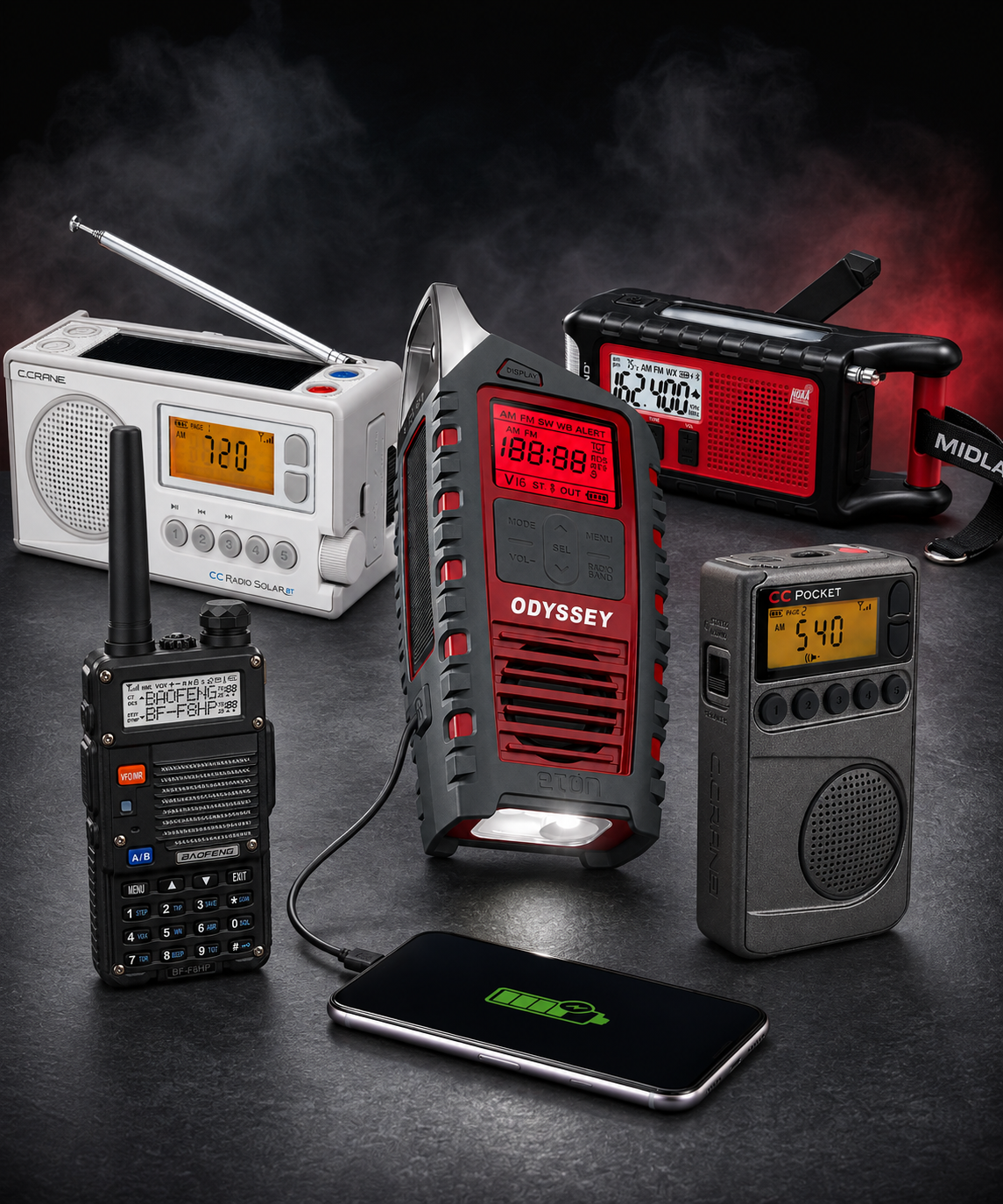
When severe weather knocks out electricity and cellular service, an emergency radio can provide critical information that a smartphone cannot. The best emergency radios receive NOAA weather broadcasts, operate from multiple power sources, and include practical survival features such as flashlights, charging ports, alert sirens, and hand cranks.
Emergency radios are available in several styles. Some are compact enough for a bug-out bag, while others offer large batteries that can provide days of listening and limited emergency power for a phone. There are also simple battery-powered weather radios for people who prefer dependability over extra features.
This guide covers the best emergency radio options for home preparedness, camping, vehicles, and backcountry emergencies.
Best Emergency Radios at a Glance
Emergency radio | Best for | Radio bands | Main power source |
|---|---|---|---|
Midland ER310PRO | Best overall | AM/FM/NOAA | 10,000mAh rechargeable battery |
Midland ER310 | Best proven alternative | AM/FM/NOAA | Rechargeable battery, crank, solar |
Kaito KA500 Voyager | Best multi-power radio | AM/FM/NOAA/shortwave | Battery pack, AA, crank, solar |
Eton Odyssey | Best all-band radio | AM/FM/NOAA/shortwave | Rechargeable battery, crank, solar |
C.Crane Solar BT | Best everyday radio | AM/FM/NOAA | Rechargeable battery, AA, crank, solar |
C.Crane Pocket Radio | Best compact choice | AM/FM/NOAA | AA batteries |
Baofeng BF-F8HP | Best advanced scanner | VHF/UHF/FM/NOAA reception | Rechargeable battery |
Best Overall
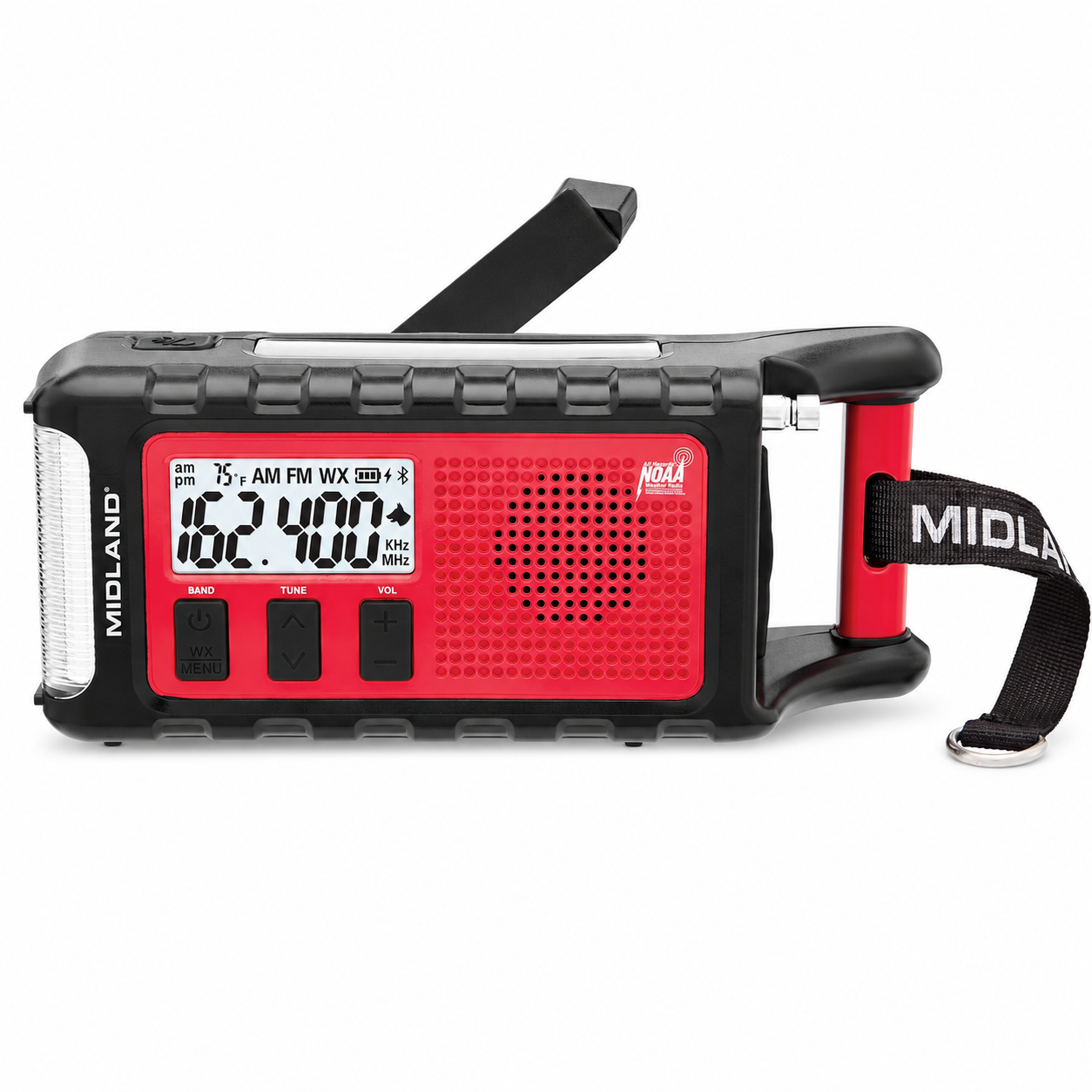
The Midland ER310PRO is one of the most complete emergency radios available. It combines a high-capacity battery, NOAA weather reception, AM/FM radio, Bluetooth, emergency lighting, and several charging options in one portable unit.
Its 10,000mAh internal battery is substantially larger than the battery found in many compact crank radios. Midland rates it for up to approximately 200 hours of radio operation, although actual runtime depends on volume, lighting, Bluetooth use, and phone charging.
The USB-C connection makes the ER310PRO more convenient than older Micro-USB emergency radios. The internal battery can also supply emergency power to compatible personal electronics. However, phone charging should be treated as a backup feature because it will reduce the radio’s operating time.
The radio includes a hand crank and solar panel for situations where normal charging is unavailable. It also has an SOS flashlight and an ultrasonic rescue-dog whistle.
- POWER BANK CHARGES EXTERNAL DEVICES - 200 hours of battery during radio use. Listen to music with Bluetooth streaming, and quickly charge your portable devices (cell phones, tablets, etc.) for emergency use using the USB charging cable (included).
- MULTIPLE, SUSTAINABLE POWER SOURCES: SOLAR PANEL - Simply recharge the internal lithium-ion battery with direct sunlight. HAND CRANK - Recharge the radio during a power outage or anytime away from a power source.
- BLUETOOTH STREAMING - Everyday utility meets emergency functionality with the ER310PRO. Connect to your phone with Bluetooth and listen to your favorite music while you wait out the storm, camp, spend time outdoors or anytime on the go.
- NOAA WEATHER SCAN + ALERT - NOAA Weather Scan will automatically scan through 7 available weather (WX) band channels and locks onto the strongest weather channel to alert you of severe weather updates.
- EMERGENCY FLASHLIGHT & RESCUE DOG SIREN - The SOS FLASHLIGHT BEACON flashes Morse code and the Bright CREE LED (130 Lumens) can be used to signal for help. The siren assists search and rescue teams in locating individuals.
Key features:
- 10,000mAh rechargeable battery
- USB-C charging
- Hand-crank and solar charging
- NOAA weather reception
- AM/FM radio
- Bluetooth speaker
- SOS flashlight
- Emergency phone-charging capability
Potential drawback: The internal battery is not designed to be replaced with ordinary AA batteries, and the radio does not carry an official water- or dust-resistance rating.
Best Proven Alternative
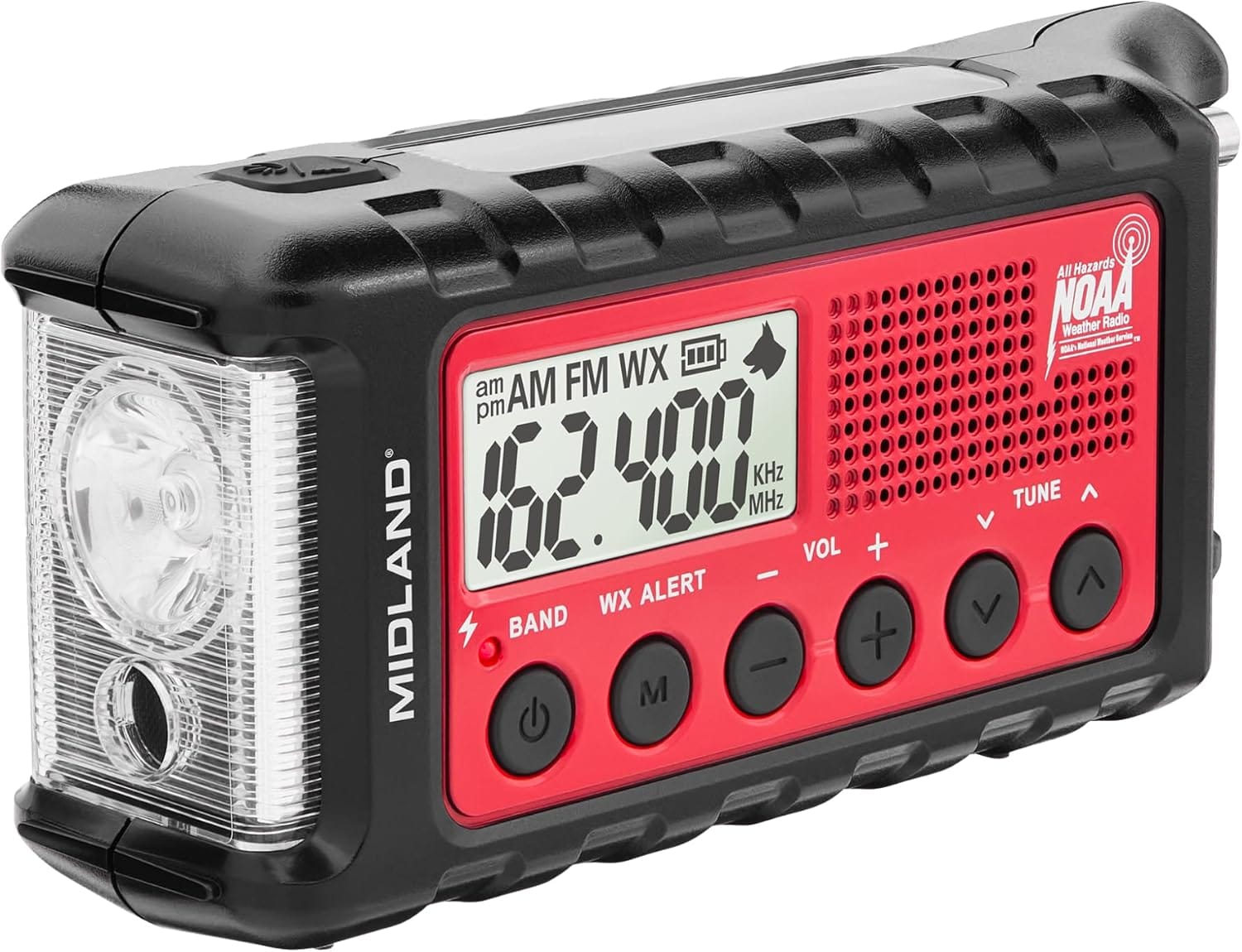
The standard Midland ER310 remains an excellent emergency radio for storm kits, vehicles, and camping. It does not offer the ER310PRO’s enormous battery, but its smaller design is easier to store and carry. Compared with many other emergency radios, this portable radio pairs a larger battery with multiple charging methods.
The radio scans available NOAA weather channels and can sound an alert when hazardous conditions are announced. That alert setting is useful for noaa weather alerts during severe storms and other weather emergencies, though it is not just a manual weather band radio mode. Its bright flashlight includes high and low settings, an SOS strobe, and a beacon designed to assist rescue personnel.
Power comes from an internal rechargeable battery, solar panel, or hand crank. The radio can also provide a limited charge to a phone through its USB output.
The ER310PRO survived a 7-foot drop without damage.
Key features:
- NOAA Weather Scan and Alert
- AM/FM reception
- Rechargeable 2,600mAh battery
- Hand-crank generator
- Solar charging panel
- SOS flashlight
- Ultrasonic dog whistle
- USB phone-charging output
The ER310 is a good option if you want a straightforward, recognizable emergency radio without paying for the larger ER310PRO battery.
Best Multi-Power Emergency Radio
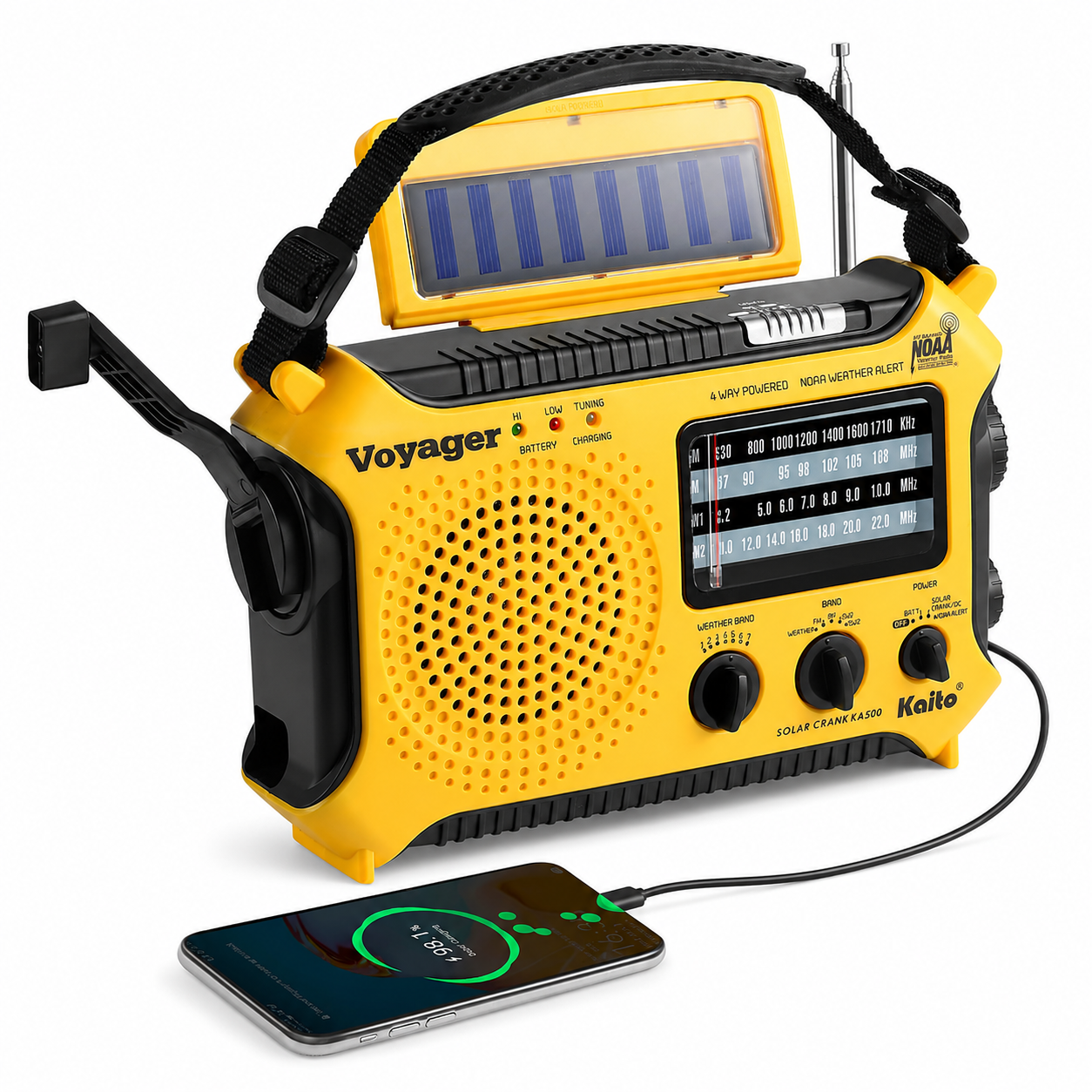
The Kaito KA500 Voyager stands out because it offers an unusually broad selection of power options. It can operate from its rechargeable battery pack, standard AA batteries, solar panel, hand crank, USB connection, or an optional wall adapter.
That flexibility is valuable during an extended outage. Rechargeable batteries can eventually lose their charge while sitting in storage, but AA battery compatibility gives you an immediate backup.
The KA500 receives AM, FM, all seven NOAA weather channels, and shortwave broadcasts. Shortwave reception may provide access to distant broadcasts, but signal quality depends heavily on atmospheric conditions, location, antenna position, and time of day.
Its rugged-looking enclosure, protective rubber edges, flashlight, reading lamp, and emergency beacon make it particularly suitable for household storm kits.
- 6-way powered portable emergency radio with hand crank generator, solar panel, compartment for 3 AA batteries (not included), 5V USB input, 5V AC/DC input with a wall power adapter (sold separately), built-in NiMH replaceable and rechargeable battery pack
- Comprehensive coverage of AM, FM, 2-band shortwave and 7 pre-programmed NOAA weather channels for entertainment, sports, talk-shows, breaking news around the world, and 24/7 real-time weather forecast (USA and Canada ONLY) with PEAS (Public Emergency Alert System)
- Works as an emergency mobile battery charger with built-in standard DC 5V USB output port for charging mobile devices, such as smart phones, GPS units, MP3 players, digital cameras, and etc. Other features include a 5-LED reading lamp, LED flashlight and a red LED S.O.S. beacon light
- Telescopic antenna extends up to 14.5" for high sensitivity reception assisted by advanced semiconductor circuitry design and LED signal strength indicator for pin-point tuning accuracy, and built-in speaker delivers loud and crispy sound
- Made of strong premium impact-resistant and water-resistant ABS material, suitable for both indoors home/office use and outdoors recreational activities
Key features:
- Six possible power methods
- AM/FM reception
- NOAA weather channels
- Shortwave reception
- Telescoping antenna
- Flashlight and reading lamp
- Red emergency beacon
- AA battery compatibility
Potential drawback: The radio is relatively large, and its small internal battery is not ideal for charging modern smartphones.
Best All-Band Emergency Radio
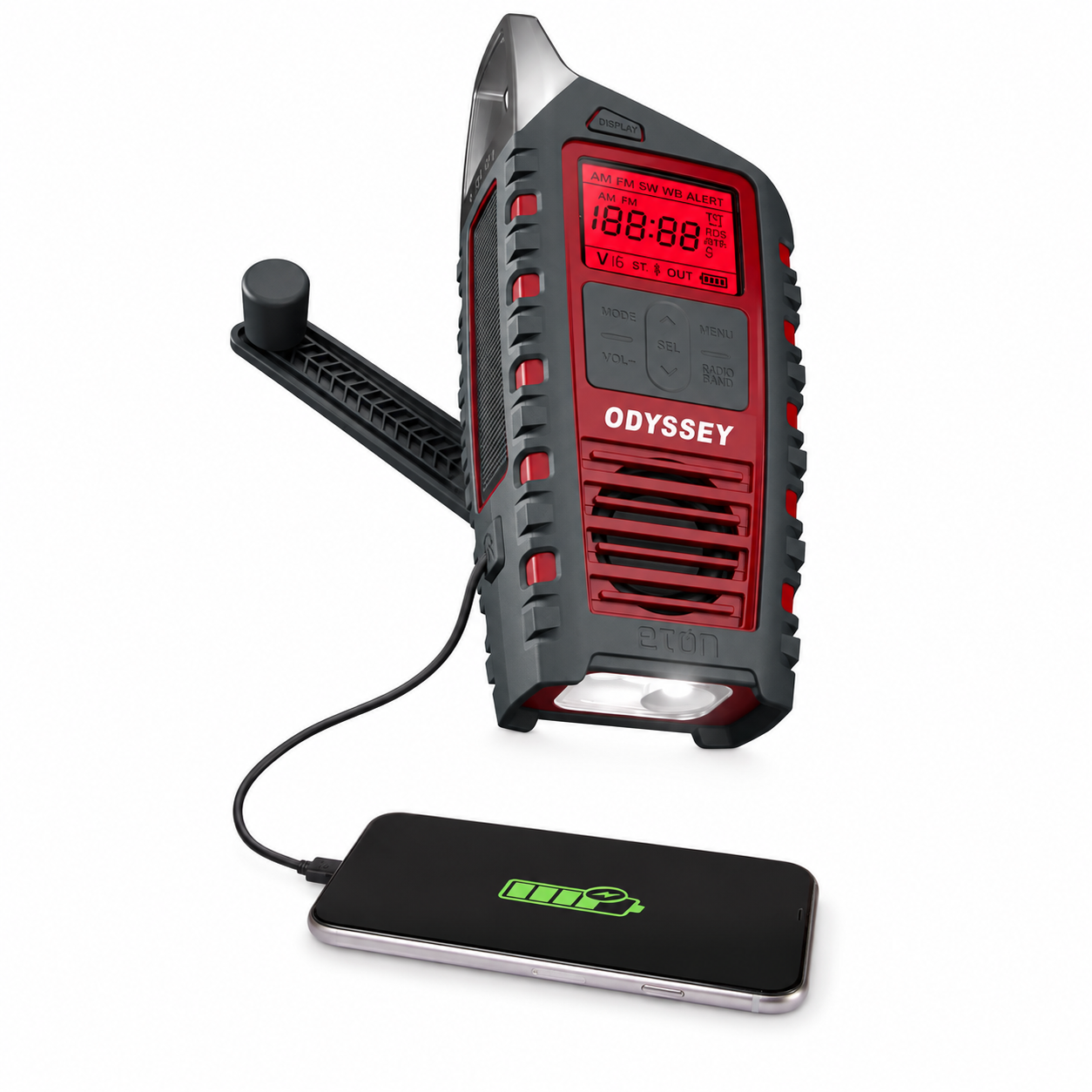
The Eton Odyssey is designed for shoppers who want more listening options than a basic NOAA weather radio provides. It combines AM, FM, NOAA weather, and shortwave reception with Bluetooth connectivity and multiple emergency features.
A digital tuner and backlit display make it easier to select a specific station than a traditional analog dial. The shortwave capability is useful for hobby listening and receiving broadcasts from outside your immediate region.
The Odyssey also includes a hand crank, solar charging, a multifunction flashlight, and a phone-charging output. Bluetooth allows the radio to serve as a wireless speaker when there is no emergency.
- NOAA Weather Alert Radio – This compact radio features comprehensive AM, FM, Shortwave, and NOAA weather bands with RDS. Stay connected to National Weather Service alerts with this storm radio, receiving both visual and audio warnings for tornadoes, floods, hurricanes, and more. Essential for preparedness or outdoor adventures.
- Multiple Power Sources – The radio includes multiple sustainable power options: a solar panel to charge the internal battery via sunlight, and a hand crank for recharging during power outages or when off-grid. It’s equipped with a rechargeable 2000mAh battery, ideal for staying powered during emergencies, storms or everyday use.
- Flashlight – Built with a super bright 3-multiple LED flashlight featuring high/low/flood settings and an emergency SOS alarm. Perfect for lighting your campsite or signaling for help in emergencies, ensuring you’re prepared for any situation.
- Digital AM/FM and Shortwave Radio with Clock – Equipped with a digital tuner, the radio offers clear AM/FM and Shortwave reception for entertainment and live updates direct from the source. The large backlit LCD display ensures easy visibility. Compact and portable, it’s perfect for outdoor adventures or your doomsday kit.
- Phone Charger and Bluetooth – Charge your devices on the go with the USB output, ensuring your smartphone and other essentials stay powered, even in remote locations. Connect via Bluetooth to stream music or content directly from your phone.
Key features:
- Digital AM/FM tuner
- NOAA weather reception
- Shortwave radio
- Bluetooth speaker
- Solar and hand-crank charging
- Emergency phone charger
- Backlit display
- Multifunction flashlight
Choose the Eton Odyssey if shortwave reception and everyday Bluetooth use are as important as emergency preparedness.
Best for Everyday Use
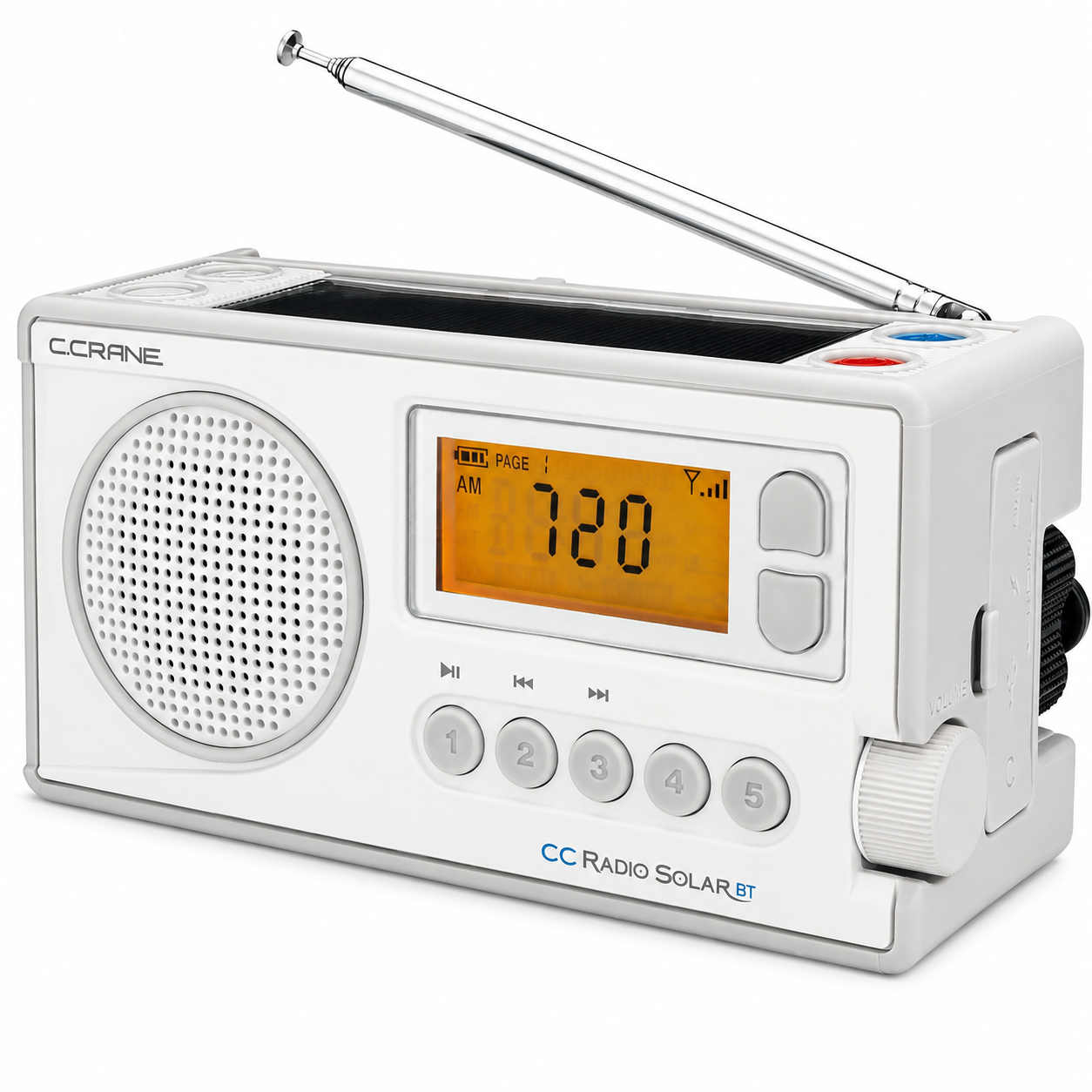
Some emergency radios spend years sitting unused in a closet. The C.Crane CCRadio Solar BT takes a different approach by combining emergency capabilities with the appearance and sound of a radio you might use every day.
It receives AM, FM, and NOAA weather stations and can operate from a rechargeable 18650 battery or ordinary AA batteries. Solar and hand-crank charging provide additional redundancy.
Bluetooth lets you play music, podcasts, or audiobooks through the radio’s speaker. This gives you a reason to operate and test the radio regularly—an important advantage because emergency equipment should be checked before it is needed.
- Powerful Performance: Compact digital portable emergency radio that also performs so well, you can use it every day. Enjoy excellent AM/FM reception and NOAA weather broadcasts with superior voice focused audio. Bluetooth receiving so you can listen to your favorite audio from your smartphone or tablet. Your phone can even act as a remote when using Bluetooth .
- High Quality with attention to detail: The solar panel is much larger than similarly sized solar radios, and the crank generator output is greater at 400mA. LED flashlight has superior light output and color. The UV-resistant rubber perimeter and concave base prevent tipping or provides excellent stability. The patented hand crank is folded and inlaid into the back. Designed in the USA with a well written instruction manual.
- Multiple Power Options: The included 3400mAh lithium-ion battery can be recharged by the wind-up hand crank, over-sized solar panel, Micro USB charging port or optional AC wall adapter (not included), or (3) “AA” alkaline batteries (not included). The lithium-ion battery is easily replaceable and will run the radio. 35-50 hours when fully charged.
- Emergency Essentials: Fold out hand crank for winding when there’s no power. Built-in LED flashlight and cell phone charger keep you prepared for any situation.
- Additional Features: Five memory Presets per band, lighted display, line-in jack, headphone jack, clock, alarm, sleep timer. 1, 9, and 10kHz tuning. Weight: 1.1 lbs. Size: 6" W x 3" H x 2.25" D. 1-year limited warranty. Dedicated U.S. based tech support.
Key features:
- AM/FM and NOAA weather reception
- Bluetooth connectivity
- Replaceable rechargeable battery
- AA battery backup
- Solar panel
- Hand crank
- Clear, powerful speaker
- Simple controls
Potential drawback: It lacks some dedicated rescue features, such as a loud warning siren or flashing emergency beacon.
Best Compact Emergency Radio
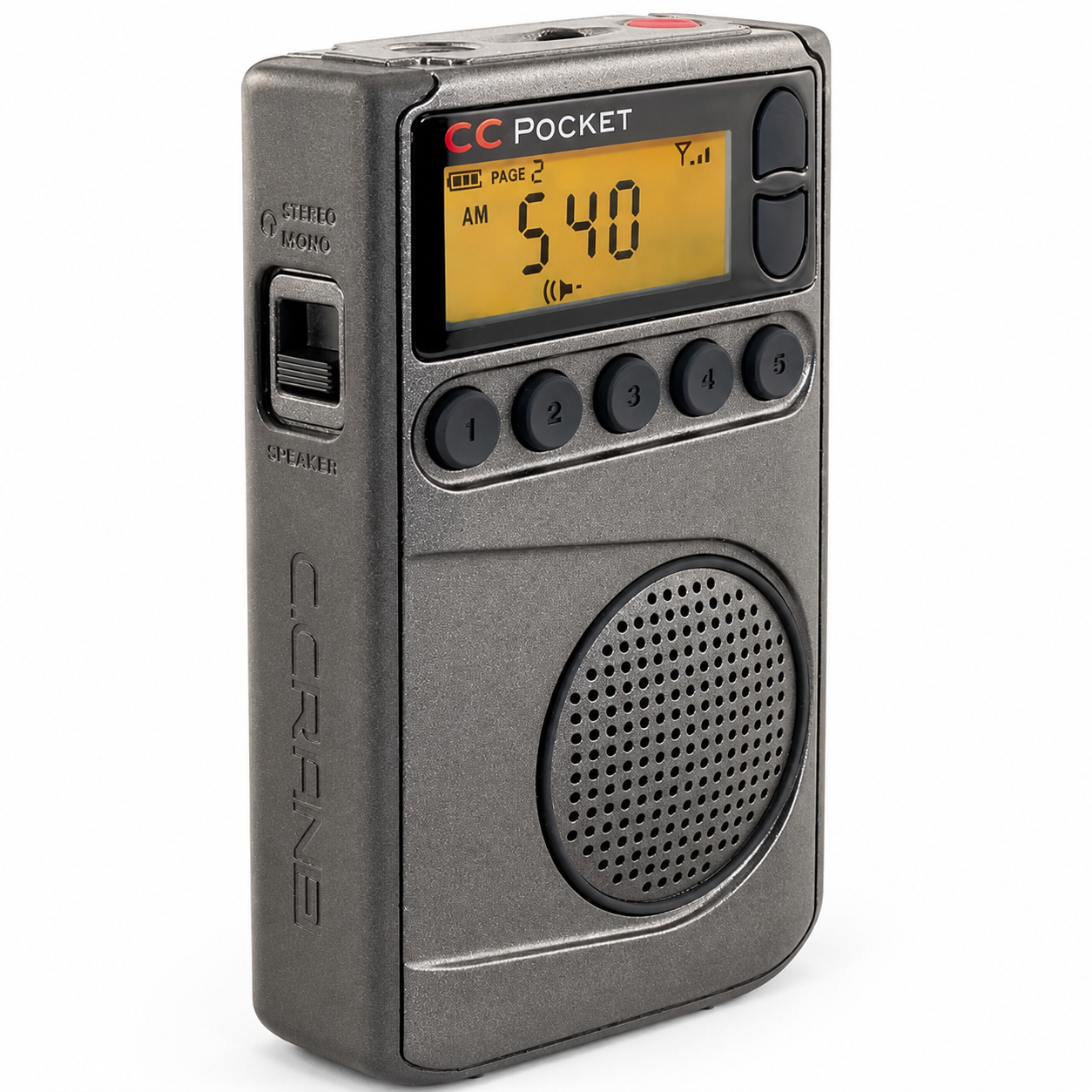
A pocket weather radio is a practical choice for hiking, traveling, vehicle storage, and compact emergency kits. The C.Crane Pocket Radio receives AM, FM, and NOAA weather broadcasts while remaining small enough to carry in a jacket pocket.
It operates on standard AA batteries, which can be easier to replace during a long outage than a proprietary battery pack. Its compact dimensions also make it easy to store with spare batteries in a sealed emergency bag.
The tradeoff is that this style of radio normally lacks a hand crank, solar panel, phone charger, large flashlight, and emergency siren.
- AM/FM and NOAA Weather Band Pocket Sized Radio
- Excellent selectivity and sensitivity for its size, 5 one touch memory presets
- Built in speaker or can be used with included earbuds
- Backlight, Sleep timer, Clock and Alarm, Removable belt clip
- Runs on (2) AA Batteries
Key features:
- Compact pocket-sized design
- AM/FM radio
- NOAA weather reception
- Weather alert function
- AA battery power
- Headphone connection
Best Advanced Mobile Scanner
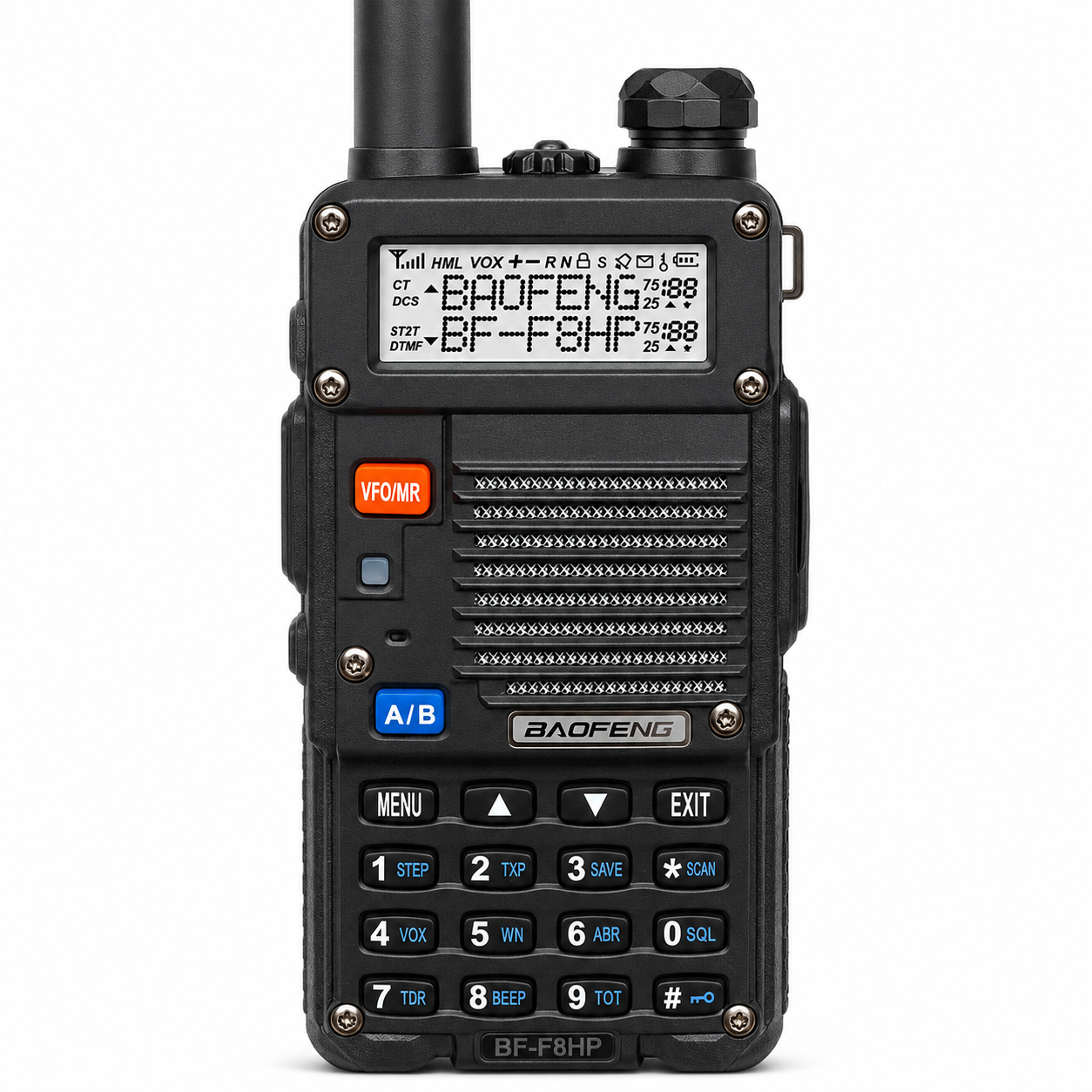
The Baofeng BF-F8HP is different from a conventional emergency weather radio. It is a programmable dual-band handheld transceiver that can monitor numerous VHF and UHF frequencies, including programmed NOAA weather channels.
It is better suited to experienced users who want to monitor multiple frequencies while hiking, off-roading, or participating in organized emergency communications.
The BF-F8HP requires programming and has a steeper learning curve than a standard Midland or Kaito radio. It also lacks several conventional emergency-radio features, including solar charging and a hand crank.
Most importantly, transmitting on amateur-radio frequencies generally requires the appropriate FCC license. Ownership and passive reception are different from transmitting, and users must follow applicable frequency and licensing rules.
- Upgrades from our Previous Generation UV-5R: Twice the Output Power (8 watts up from 4 watts output), New Hardened Durable Radio Shell, 30% Larger Battery, V-85 High Gain Antenna (Twice the Antenna Performance), USA Support + In-depth User Guide Included; A PC03 FTDI Programming Cable is Recommended for Easier PC Programming
- High / Med / Low Power Settings (8W, 4W, 1W); Frequency Range: VHF: 136-174 MHz(Rx/Tx). UHF: 400-520 MHz(Rx/Tx); Broad (Wide) / Narrowband (Narrow) Selectable
- The BF-F8HP was designed in the USA and because not everyone is a radio-expert we really wanted to focus on providing an easier user experience! That starts with the new in-depth manual that guides you through the capabilities and customization of the BF-F8HP. On top of that the BF-F8HP also includes exclusive concierge customer help and warranty support. This concierge service is only available on select BaoFeng models such as the BF-F8HP, UV-82HP, and UV-5X3.
- Kit Includes: BF-F8HP, 2100mAh Battery, V-85 Dual Band Antenna, CH-5 Charger, CH-5 110V Adapter, Earpiece Kit, Wrist Strap, Belt Clip, User Manual
- BTECH is proud to be in the USA, which allows you to have the best available local support for any issue that may arise. BTECH only engineers and develops radio products. That brand focus allows you to have the best available radios and accessories with the most features, with real USA warranty and support.
Key features:
- Dual-band VHF/UHF capability
- Programmable channels
- NOAA reception when correctly programmed
- Replaceable antenna
- Rechargeable battery
- Built-in flashlight
- Compact handheld design
Different Styles of Emergency Radios
Hand-Crank Emergency Radios
Hand-crank radios use a small generator to supply power when batteries and outlets are unavailable. The crank is an emergency backup—not the most efficient way to keep a large battery fully charged.
A few minutes of cranking may provide enough power to hear an important forecast, but it should not replace normal USB charging.
Solar Emergency Radios
A built-in solar panel can slowly maintain or supplement the battery on a hand crank emergency radio, and its solar charging ability is most useful when other power sources are unavailable. Small panels usually work best in strong, direct sunlight and may take a long time to produce a meaningful charge.
Hand cranking is more concrete as a backup: one minute of hand cranking may provide about 20 minutes of radio play, while some models claim up to 32 minutes of listening time. Solar should still be considered a secondary charging method rather than the radio’s primary power source.
Battery-Powered Weather Radios
Radios that use AA, AAA, C, or D batteries are simple and dependable. They can remain in storage without depending on the health of a built-in lithium battery.
Store spare batteries separately and check their expiration dates regularly. This reduces the risk of leakage damaging the radio.
Desktop Weather-Alert Radios
Desktop weather radios are designed mainly for the home. Many remain plugged into an electrical outlet and use batteries for backup power.
Look for NOAA alert capability and SAME technology if you want warnings targeted to a specific county or geographic area.
Pocket Weather Radios
Pocket models prioritize size and battery life. They are excellent for hiking, vehicle kits, and evacuation bags but usually omit large batteries, solar panels, and powerful emergency lights.
Shortwave and Scanner Radios
Shortwave radios receive broadcasts from much farther away than ordinary local AM/FM stations under favorable conditions. Programmable scanners and transceivers can cover additional frequencies but require more technical knowledge.
They should supplement—not replace—a simple NOAA weather-alert radio.
How to Choose the Best Emergency Radio
NOAA Weather Reception
A dependable emergency radio should receive all seven NOAA Weather Radio frequencies. NOAA stations broadcast official weather forecasts, watches, warnings, and other hazard information around the clock in supported areas.
A radio with an automatic alert mode is preferable to one that only receives the weather channels manually.
Battery Capacity
A larger battery generally provides longer radio runtime and more useful emergency phone charging. However, it also adds size, weight, charging time, and cost.
For home use, a larger battery makes sense. For a backpack, a lighter radio with replaceable batteries may be more practical.
Multiple Power Sources
The strongest emergency radios provide at least three charging or power methods:
- USB or USB-C charging
- Hand-crank charging
- Solar charging
- Replaceable battery backup
No single power source is perfect. Redundancy is what makes an emergency radio dependable.
Digital vs. Analog Tuning
Digital radios make it easy to select an exact frequency and store presets. Analog radios are typically simpler and may be easier to operate without navigating menus.
Either style can work well. Reception quality and antenna performance matter more than the appearance of the display.
Flashlight and Emergency Beacon
A built-in flashlight reduces the number of separate tools required in a storm kit. SOS strobes and red emergency beacons can help attract attention, but they do not replace a dedicated high-output flashlight.
Phone-Charging Capability
Emergency radios are not substitutes for full-size power banks. A small radio battery may only add enough phone power for a short call or text.
If communication is critical, store a charged power bank beside the radio and reserve the radio’s battery for receiving broadcasts.
Durability and Water Resistance
Look for protected controls, a sturdy antenna, secure battery doors, and rubberized edges. An official IP rating is helpful when the radio will be used outdoors.
Even when a model looks rugged, keep it inside a waterproof bag unless the manufacturer specifically identifies it as water-resistant.
Frequently Asked Questions
What is the best emergency radio for home use?
The Midland ER310PRO is one of the strongest all-around choices because it combines NOAA reception, a large 10,000mAh battery, USB-C charging, a hand crank, solar charging, Bluetooth, and emergency lighting.
Will an emergency radio work without electricity?
Yes. Depending on the model, it may operate from a rechargeable battery, disposable batteries, hand crank, or solar panel. Charge the radio before severe weather arrives instead of relying entirely on the crank or solar panel.
Does every emergency radio receive NOAA alerts?
No. Some radios receive NOAA frequencies but do not automatically sound an alert. Check specifically for “NOAA Alert,” “Weather Alert,” or SAME functionality.
Can an emergency radio charge a smartphone?
Many can provide limited phone charging, but performance depends on battery capacity. A 10,000mAh radio is more useful for this purpose than a model with a small internal battery. Keep a separate power bank as your primary phone backup.
Is a hand crank enough to charge a phone?
Not efficiently. A hand crank may provide enough power for an urgent call, message, or brief period of radio listening, but fully charging a modern phone by hand would take considerable effort.
Are solar emergency radios dependable?
Solar panels can extend runtime or slowly replenish a battery in strong sunlight. Because compact panels charge slowly, they work best as a backup to USB charging, disposable batteries, or a hand crank.
Do I need a ham radio license for an emergency radio?
You do not need a license to use an ordinary receive-only AM/FM/NOAA emergency radio. A license is generally required to transmit on amateur-radio frequencies with a device such as the Baofeng BF-F8HP, except where narrow legal emergency exceptions apply.
How often should I test my emergency radio?
Test it every three to six months and before forecast severe weather. Charge the battery, confirm local NOAA reception, inspect the battery compartment, test the flashlight, and replace expired disposable batteries.
Final Thoughts
The best emergency radio is one you can operate easily, keep powered, and receive clearly from your location. For most homes, the Midland ER310PRO offers the strongest overall combination of battery capacity, weather reception, modern USB-C charging, and emergency features.
The Kaito KA500 is a smart choice for people who prioritize multiple power options and shortwave reception. The C.Crane Solar BT is better suited to shoppers who want an emergency radio they can also enjoy every day, while a compact C.Crane pocket model works well in a hiking pack or vehicle.
Whatever style you choose, charge and test it before storm season. Store it with spare batteries, charging cables, a separate power bank, and a printed list of local emergency information. Official NOAA weather broadcasts and alert terminology are explained by the National Weather Service, while radio-transmission licensing information is available from the Federal Communications Commission. Order today!